
Skip to tool

MIYAIP TOOLS

URL Parser

Separate a URL into its protocol, host, port, path, query and fragment. Compare raw query values with their decoded values, including repeated parameters and nested encoding.

URL input and parsed components

Your input is processed locally in this browser.

Up to 8,192 characters per address

Results

Enter input or load an example.

Keep repeated query parameters visible

Consider this fictional URL:

https://example.com:8443/catalog/items?tag=desk&tag=light&query=desk+lamp&return=%252Faccount#details
Component Parsed value
Protocol https:
Host example.com:8443
Path /catalog/items
Fragment #details
Raw key Raw value Decoded key Decoded value
tag desk tag desk
tag light tag light
query desk+lamp query desk lamp
return %252Faccount return %2Faccount

Both tag entries remain in order. Collapsing them into one dictionary property would discard a value. Form-style query decoding converts + to a space and decodes percent escapes once. It does not repeatedly decode %252F into /.
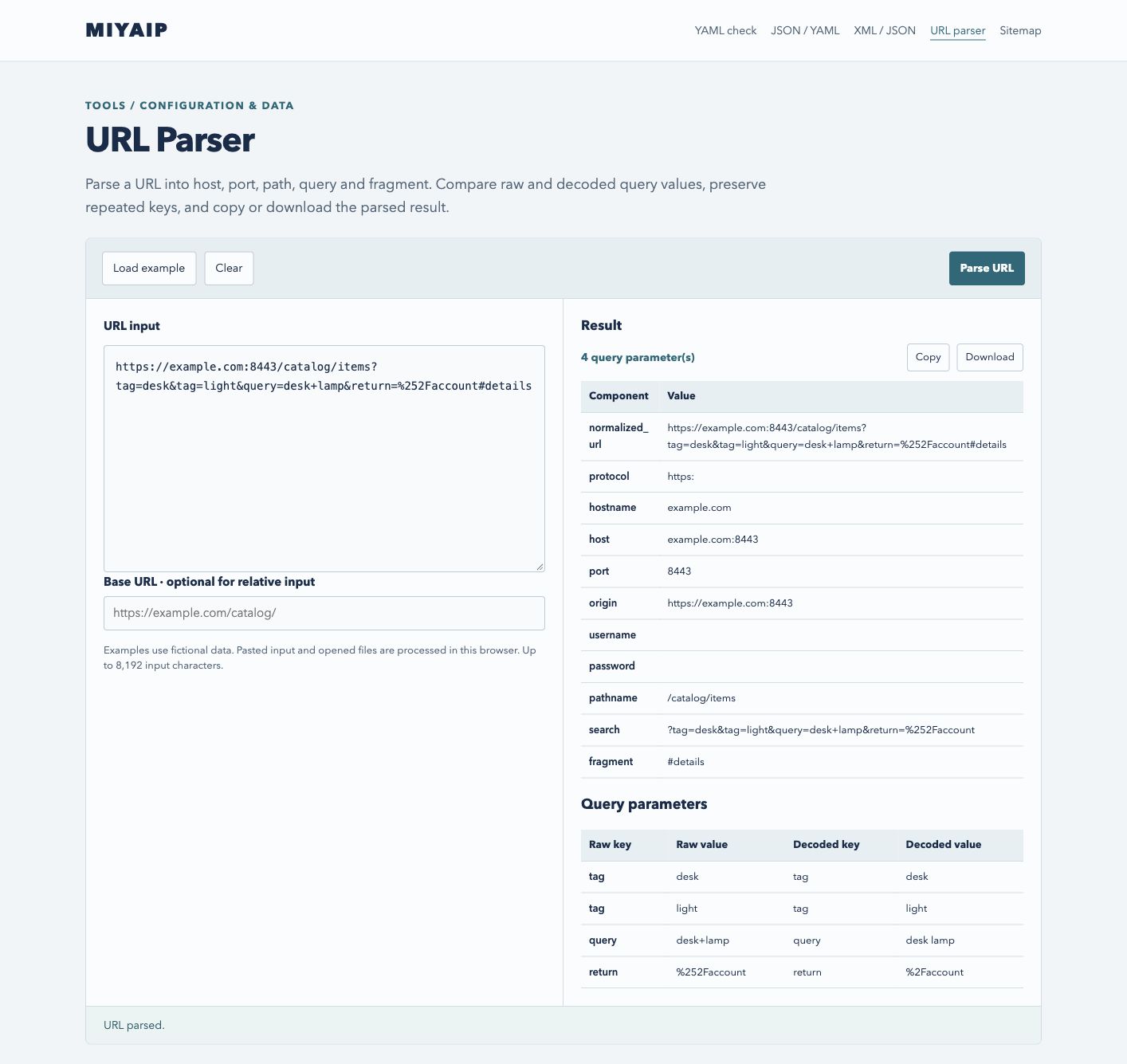
URL parser showing two tag values and raw versus decoded query parameters.
Repeated tag parameters stay in order; plus signs and percent escapes are decoded once.

Resolve a relative reference with the right base

Parse ../items?limit=20 with a base of https://example.com/catalog/pages/ to obtain:

https://example.com/catalog/items?limit=20

A trailing slash changes how the final base segment is treated. Use the actual document or response URL when resolving links from a page, rather than an assumed site root.

The parser follows the browser's WHATWG URL rules. Default ports may disappear from the normalized URL. Host casing, internationalized domains and dot segments can also normalize. The raw query columns refer to the query representation after URL parsing, not a byte-for-byte archive of the entire input.

Distinguish parsing from server behavior

The fragment identifies a location within a document and is not sent as part of an HTTP request target. A server may give repeated parameters its own meaning, and signed URLs may depend on their exact order or encoding.

The JSON export includes a has_equals flag, so ?flag can be distinguished from ?flag=. It also includes any username and password already present in the URL. Remove credentials before sharing an export. Malformed percent escapes produce a warning rather than a claim that the URL is suitable for a request.

FAQ

Frequently asked questions

Does a parsed URL prove the page exists?

No request is sent. Use an HTTP client to check status codes, redirects and the returned content.

Does this decode the path like a query string?

The path remains a URL component. Query decoding uses query-string rules; applying those rules to an entire path can change its meaning.

Can this check my proxy's location?

The parser only explains the address. Use IP Lookup or What Is My IP to inspect an actual network result.

Continue with MIYAIP

Use the resulting data with the intended client or check the connection from the environment where it will run.

Look up an IP address