
The best proxy providers are not simply the companies with the largest advertised IP pools.
A provider can look impressive on paper and still be a poor fit if it lacks the proxy type, location precision, session behavior, protocols, or reliability your workload actually needs.
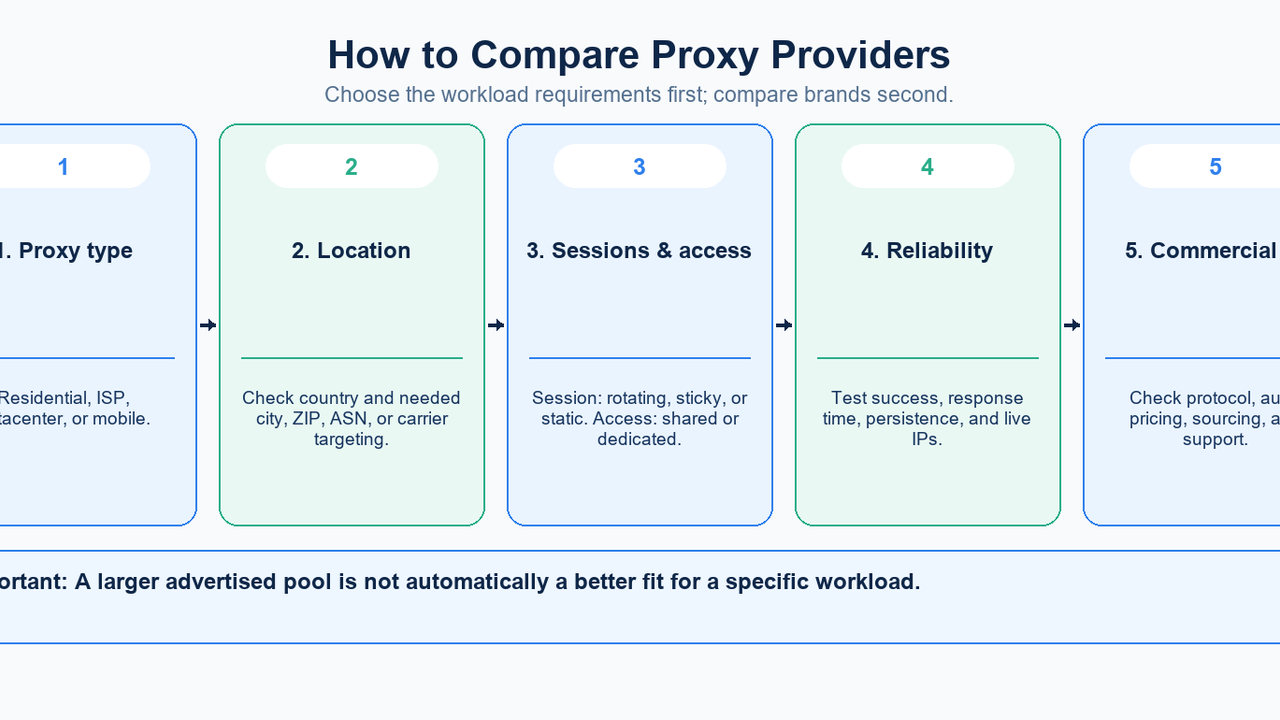
A useful comparison therefore starts with five questions:
1. Which proxy type do you need?
2. Which locations and targeting controls matter?
3. What session behavior and allocation model do you need?
4. How does the service perform on your real workload?
5. Does the pricing and support model fit your scale?
This guide compares eight established providers and separates vendor-reported product claims from independent 2026 benchmark data where that data exists.
Quick Answer
The providers worth comparing first are:
- Decodo — broad self-service catalog across residential, ISP, datacenter, and mobile proxies.
- Oxylabs — large residential network and enterprise-oriented proxy infrastructure.
- Bright Data — very broad advertised network, location coverage, and proxy tooling.
- SOAX — strong focus on residential/mobile networks and configurable sessions.
- Webshare — straightforward self-service options across datacenter, residential, and ISP/static-residential products.
- IPRoyal — flexible purchasing with residential, ISP, datacenter, and mobile products.
- Rayobyte — developer-facing proxy products with explicit feature and protocol documentation.
- DataImpulse — PAYG residential proxies with non-expiring traffic and a simple cost model.
There is no single provider that is best for every workload.
The better approach is to choose the required proxy architecture first, then compare providers that can meet it.
How We Compare Proxy Providers
A proxy-provider comparison should not start with brand names.
Start with the workload.
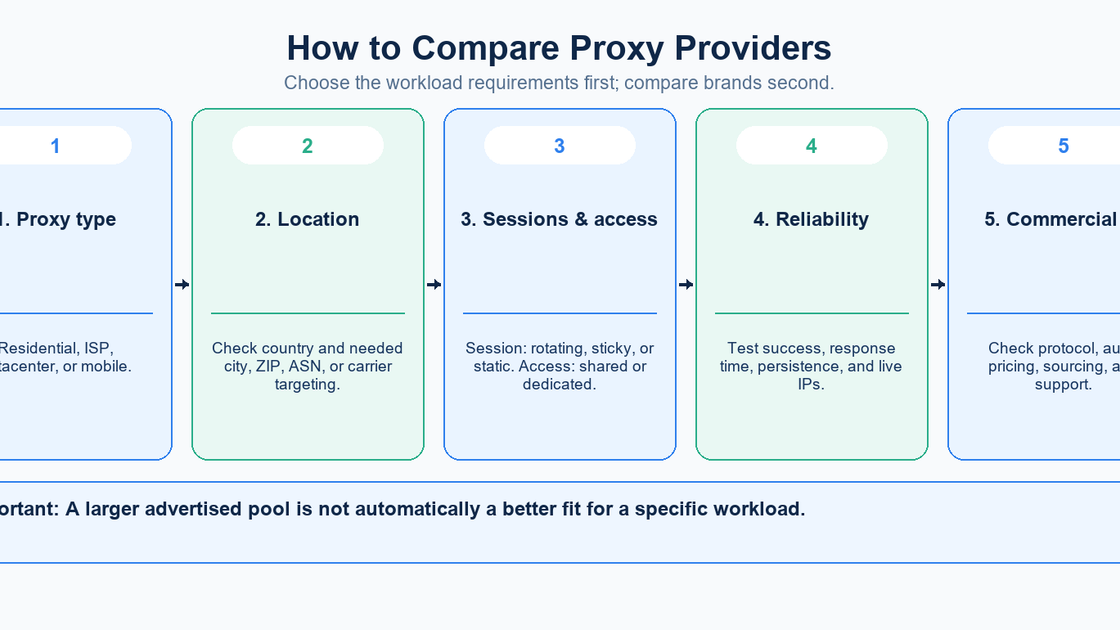
1. Proxy type
Residential, ISP/static residential, datacenter, and mobile proxies come from different network environments.
A large residential network does not replace a requirement for a dedicated datacenter IP, and a mobile pool does not automatically make sense for an ordinary localization test.
2. Location coverage
“195 countries” is useful, but incomplete.
You may actually need:
- country targeting;
- state or region targeting;
- city targeting;
- ZIP/postal-code targeting;
- ASN or ISP targeting;
- mobile-carrier targeting.
The important question is whether the required control exists for the specific proxy product you plan to buy.
3. Session behavior and allocation
Separate IP source, session behavior, and allocation rather than treating them as one proxy type.
For session behavior, you may need:
- rotation on every request;
- a sticky IP for a defined period;
- a static IP.
For allocation, check whether access is shared or dedicated. Separately, verify the required HTTP(S)/SOCKS5 protocol and authentication method. These dimensions affect application behavior even when two products use the same IP-source type.
4. Reliability evidence
Do not treat one vendor-reported “99.9%” figure as a complete reliability model.
Proxyway's 2026 Proxy Market Research tested providers over millions of requests and also measured unique IPs observed over time. That matters because an advertised pool size is not the same as the number of IPs that are live, reachable, correctly located, or useful for one target at one moment.
5. Commercial and operational fit
Finally compare:
- pay-per-GB vs pay-per-IP;
- PAYG vs subscription;
- API and sub-user controls;
- authentication options;
- documentation;
- support;
- sourcing/compliance information;
- trial or test options.
A lower sticker price is not cheaper if the workload produces more failed requests or requires more retries.
Best Proxy Providers to Compare
The list below is deliberately a shortlist, not a universal ranking.
Provider catalogs and advertised pool sizes change. The descriptions reflect information available from provider documentation and independent benchmark sources as of October 2026.
Provider snapshot
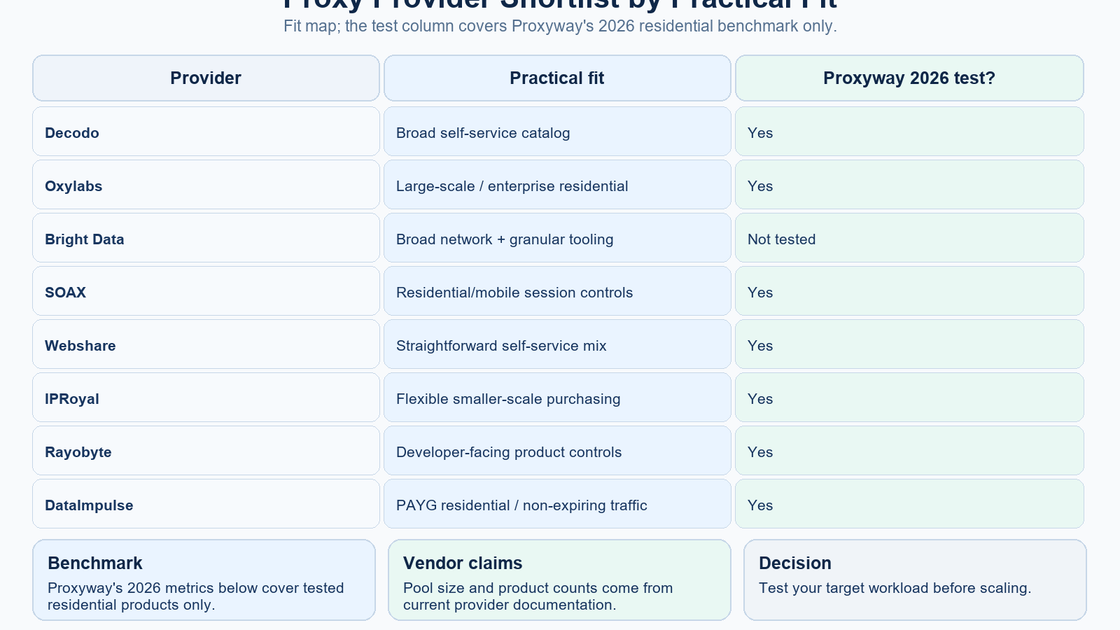
Provider | Product breadth | Practical reason to compare it | Independent 2026 residential benchmark |
|---|---|---|---|
Decodo | Residential, ISP, datacenter, mobile | Broad self-service catalog | Yes |
Oxylabs | Residential, ISP, datacenter and related data products | Large-scale and enterprise workloads | Yes |
Bright Data | Residential, ISP, datacenter and broader data tooling | Broad advertised network and targeting | Not in Proxyway 2026 residential benchmark |
SOAX | Residential and mobile, with additional network options by product/location | Session and geo controls | Yes |
Webshare | Residential, ISP/static residential, datacenter | Simple self-service mix | Yes |
IPRoyal | Residential, ISP, datacenter, mobile | Flexible purchase models | Yes |
Rayobyte | Residential, ISP, datacenter, mobile products | Detailed developer documentation | Yes |
DataImpulse | Residential, datacenter, mobile | PAYG and non-expiring residential traffic | Yes |
Independent 2026 Residential Benchmark Snapshot
Independent benchmark numbers are useful only if you interpret them correctly.
Proxyway's 2026 residential proxy benchmark reports the following infrastructure measurements for the tested residential products under the same benchmark methodology:
Provider | Success rate | Average response time |
|---|---|---|
Decodo | 99.92% | 0.53 s |
Oxylabs | 99.93% | 0.60 s |
SOAX | 99.78% | 0.89 s |
Webshare | 99.28% | 0.86 s |
IPRoyal | 96.11% | 1.24 s |
Rayobyte | 98.02% | 1.86 s |
DataImpulse | 99.74% | 0.97 s |
Bright Data | Not tested in this benchmark | Not tested |
These numbers should not be turned into a provider-wide score.
They describe particular residential-proxy tests under Proxyway's methodology. They do not directly tell you how the same company will perform with datacenter, ISP, mobile, or a different target workload.
That distinction is important.
1. Decodo
Decodo's current proxy catalog advertises residential, ISP, datacenter, and mobile proxy products across 195+ locations.
It is one of the easier providers to compare because the catalog covers the four major commercial proxy categories in one platform.
Current product documentation also describes:
- HTTP(S) and SOCKS5 support;
- rotating and sticky residential sessions;
- static/dedicated options in relevant products;
- multiple geo-targeting levels.
Decodo also participated in Proxyway's 2026 residential benchmark, which gives buyers an external performance reference in addition to vendor claims.
Good fit to compare when: you want a broad self-service catalog and would prefer not to use separate vendors for residential, ISP, datacenter, and mobile needs.
2. Oxylabs
Oxylabs' residential proxy page currently advertises a 175M+ residential network across 195+ countries.
Its current catalog also includes ISP and multiple datacenter proxy formats, including shared, rotating, and dedicated datacenter products.
Oxylabs is particularly relevant when procurement involves:
- large traffic volumes;
- enterprise support expectations;
- granular targeting;
- a large residential network;
- multiple proxy products under one vendor.
It also participated in Proxyway's 2026 benchmark and posted strong residential infrastructure results in that test.
Good fit to compare when: scale, enterprise support, and large residential inventory matter more than finding the smallest entry plan.
3. Bright Data
Bright Data's proxy-services page currently advertises residential, ISP, and datacenter networks and a very large global proxy footprint.
Its location documentation advertises coverage in 195 countries and targeting that can extend to country, city, ZIP code, carrier, and ASN depending on product.
Bright Data is therefore worth comparing when the requirement includes:
- broad location coverage;
- granular geo controls;
- multiple proxy networks;
- proxy management and broader data-collection tooling.
One important evidence caveat: Bright Data did not participate in Proxyway's 2026 residential benchmark, so the benchmark table above has no directly comparable 2026 residential success-rate/latency result for it.
That does not mean the service is unreliable. It means you should not invent a cross-provider benchmark value that was never measured in that test.
Good fit to compare when: breadth of infrastructure and targeting controls matter, especially in a larger data stack.
4. SOAX
SOAX's current proxy overview emphasizes residential and mobile proxy networks and flexible request/session controls.
Its location pages also document country, region, and city targeting, with additional controls such as ASN or carrier targeting in relevant products.
SOAX is useful to compare when your main requirement is not simply “many countries,” but:
- residential/mobile coverage;
- fine session control;
- rotating vs sticky behavior;
- geo and network targeting.
It also has current independent residential benchmark data from Proxyway.
Good fit to compare when: residential/mobile session behavior and targeting flexibility are central to the workload.
5. Webshare
Webshare's proxy features page documents HTTP and SOCKS5 support and multiple proxy products.
Its current help documentation also separates datacenter proxy access into shared/premium, private, and dedicated-style tiers, while its ISP/static-residential products use ISP-associated addresses hosted on server infrastructure.
That makes Webshare worth comparing when you want a relatively direct self-service model and need to choose between:
- datacenter;
- residential;
- static residential/ISP;
- shared vs more exclusive address access.
Webshare also appears in Proxyway's 2026 residential benchmark.
Good fit to compare when: you want a relatively simple dashboard/product structure and multiple access tiers without an enterprise-first procurement process.
6. IPRoyal
IPRoyal's current proxy-services page lists ISP, rotating residential, datacenter, and mobile products.
Its residential documentation also highlights:
- HTTP(S) and SOCKS5;
- rotating and sticky sessions;
- country/state/city targeting;
- traffic that does not expire after purchase.
That last point changes the commercial comparison because unused residential traffic is not necessarily tied to the same monthly-expiration model as some subscription products.
IPRoyal also participated in Proxyway's 2026 residential benchmark.
Good fit to compare when: smaller or intermittent workloads benefit from flexible purchasing and you want access to all four common proxy categories.
7. Rayobyte
Rayobyte's proxy documentation is unusually explicit about feature differences between products.
Its current docs separate residential, rotating ISP, and rotating datacenter offerings and show which targeting or protocol controls belong to which product.
Rayobyte's mobile proxy support guide also documents a separate mobile pool, with access and bandwidth managed separately from its residential service.
For example, the residential product receives the broadest targeting and protocol feature set in the current documentation, while other products expose more limited controls.
This matters because buyers often assume a feature listed on a provider's homepage applies to every proxy product.
It may not.
Good fit to compare when: engineers want clear product-level documentation and need to verify exactly which protocol or targeting feature is available on which proxy type.
8. DataImpulse
DataImpulse's residential proxy page currently advertises a 90M+ residential pool across 195 countries.
Its model is notably simple:
- pay by traffic;
- residential traffic does not expire;
- rotating and sticky sessions;
- HTTP(S) and SOCKS5;
- country targeting plus additional granular targeting options.
The broader service also advertises residential, datacenter, and mobile products.
DataImpulse participated in Proxyway's 2026 market research, so independent testing exists alongside its vendor documentation.
Good fit to compare when: PAYG, non-expiring residential traffic, and a simple bandwidth model matter more than a complex enterprise contract.
Choose the Proxy Type Before the Provider
A common buying mistake is choosing a brand first and a proxy type second.
Reverse that order.
Residential proxies
Residential proxies use addresses associated with consumer ISP networks and often come from real end-user devices.
They are typically sold by bandwidth and are useful when a workload requires broad geographic diversity or residential network identity.
ISP / static residential proxies
ISP proxies use ISP-associated addresses hosted on stable server infrastructure.
They are useful when the workload needs a persistent address rather than continuous rotation.
Datacenter proxies
Datacenter proxies come from hosting or server infrastructure.
They are generally easier to provision at high volume and are often sold by IP, bandwidth, or both.
Mobile proxies
Mobile proxies use addresses associated with mobile-carrier networks.
They are relevant when the application specifically needs mobile-network representation or carrier/location testing.
The key point is that these are different input requirements.
A provider with an excellent residential product may not be your best datacenter choice, and vice versa.
How to Compare Locations
Provider location claims need more scrutiny than a country count.
Ask four separate questions.
Is the country available?
This is the broadest level.
Many major providers advertise coverage across roughly 195 countries or locations.
What targeting precision is supported?
A provider may offer:
- country only;
- state/region;
- city;
- ZIP/postal code;
- ASN/ISP;
- mobile carrier.
Do not assume every targeting level exists on every proxy product.
Is there enough live inventory in the exact location?
A network can advertise a country but have far fewer active IPs there than in the US, UK, or Germany.
That is where a small real-world test is more useful than the marketing coverage map.
Does the location stay correct across the session?
If you need a sticky session, verify that:
- the session remains active for the required duration;
- the exit remains in the requested geography;
- reconnect behavior is predictable.
How to Test Reliability
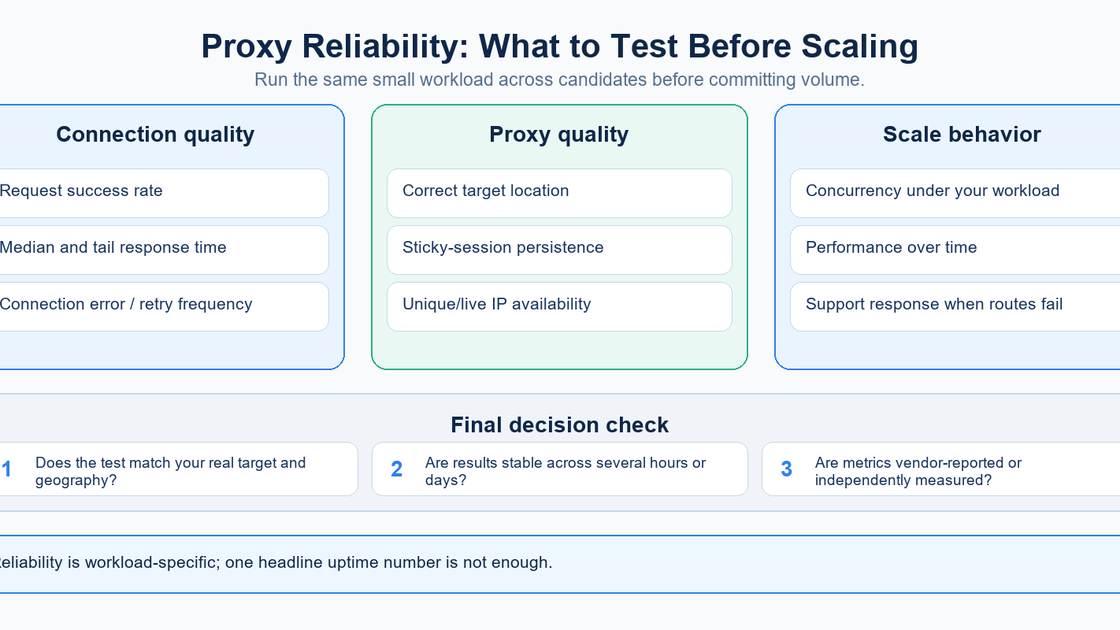
“Reliable proxy provider” should be translated into measurable checks.
Before committing volume, run the same representative workload against each serious candidate.
Measure:
Request success rate
What percentage of requests complete successfully under your normal workload?
Response time
Do not look only at an average.
Track at least:
- median response time;
- slow-tail requests;
- timeouts.
Location accuracy
Verify that exits match the location requested.
Session persistence
If a sticky or static session is required, check whether the same usable exit persists for the needed workflow.
Live/unique IP availability
For rotating pools, observe how much useful diversity you actually receive over time.
This is one reason Proxyway's 2026 research is useful: it did not rely only on advertised pool totals and instead observed unique IPs across sustained request volumes.
Concurrency and scaling
A service that performs well at 10 concurrent requests may behave differently at 100 or 1,000.
Test the level you expect to run.
The goal is not to reproduce a lab benchmark.
It is to answer:
Does this provider remain stable on my real target, location, session pattern, and concurrency?
How to Compare Pricing
Proxy pricing is difficult to compare because providers sell different units.
Common models include:
- price per GB;
- price per IP;
- monthly subscription;
- PAYG;
- volume commitment;
- dedicated-IP rental.
A $1/GB residential plan and a $1/IP datacenter plan are not directly comparable.
Instead calculate a workload-level cost such as:
total cost / successful requests
or:
total cost / usable data collected
Also account for:
- failed requests;
- retries;
- unused subscription traffic;
- targeting surcharges;
- dedicated-IP fees;
- minimum commitments;
- support requirements.
Pricing changes frequently, so verify the current plan page before purchasing rather than treating a comparison article as a permanent price sheet.
Provider Selection Checklist
Before buying, confirm:
- the correct proxy type exists;
- the exact target country/region/city is available;
- targeting depth is supported on that product;
- rotation or sticky-session behavior matches the workflow;
- required HTTP(S)/SOCKS5 support exists;
- authentication fits the application;
- the service can handle expected concurrency;
- reliability has been tested on the real workload;
- vendor-reported claims are distinguished from independent benchmarks;
- the pricing unit matches how you consume traffic;
- support and sourcing/compliance information are sufficient for your organization.
That checklist is more useful than selecting the first provider with the largest pool number.
FAQ
What are the best proxy providers?
Established providers worth comparing include Decodo, Oxylabs, Bright Data, SOAX, Webshare, IPRoyal, Rayobyte, and DataImpulse. The right choice depends on proxy type, location requirements, session behavior, reliability, scale, and pricing model.
Which proxy provider has the biggest network?
Advertised network sizes change and use different counting methods. Bright Data currently advertises 400M+ monthly proxy IPs, Oxylabs advertises 175M+ residential proxies, Decodo advertises a 125M+ overall proxy footprint, and other providers publish their own pool totals. These figures should be treated as vendor-reported network claims, not directly interchangeable measures of live usable IPs.
Does a bigger proxy pool mean better performance?
No. A larger pool can provide more potential diversity, but real performance also depends on how many relevant IPs are live, their location and quality, routing, session behavior, and the target workload.
Which providers have independent 2026 benchmark data?
Proxyway's 2026 residential research includes Decodo, Oxylabs, SOAX, Webshare, IPRoyal, Rayobyte, DataImpulse, and several other providers. Bright Data did not participate in that residential benchmark.
What is the difference between residential and ISP proxies?
Residential proxies generally use consumer-network IPs and often rotate through a larger pool. ISP/static-residential proxies use ISP-associated addresses hosted on stable server infrastructure and are commonly used when a longer-lived address is required.
Should I choose rotating or sticky proxies?
Use rotation when the workload benefits from changing exit addresses. Use a sticky session when a multi-step process needs the same exit for a defined period. The correct behavior depends on the application.
How should I test a proxy provider?
Run a small sample of the real workload and measure success rate, response time, errors/retries, location accuracy, session persistence, unique/live IP availability, and concurrency behavior.
Are vendor success rates comparable?
Not necessarily. Vendors may use different targets, geographies, request counts, or definitions of success. Compare like-for-like independent tests where possible and then validate against your own workload.
Is the cheapest proxy provider the best value?
Not necessarily. Price per GB or IP does not account for failed requests, retries, unusable locations, support, or session stability. Cost per successful workload unit is a better comparison.
Final Takeaway
The phrase best proxy providers sounds like it should produce one ranked list.
In practice, the decision is multidimensional.
Start with:
1. proxy type;
2. location and targeting depth;
3. rotation/session requirements;
4. protocol and authentication needs;
5. real workload reliability;
6. pricing model and operational support.
Then compare providers.
Decodo, Oxylabs, Bright Data, SOAX, Webshare, IPRoyal, Rayobyte, and DataImpulse all have legitimate reasons to enter a shortlist, but they do not solve every proxy workload equally well.
The strongest purchase process is therefore:
requirements → shortlist → small benchmark → scale
That approach is more reliable than choosing by advertised pool size or a single “best overall” label.
Explore more proxy insights
Sources
- Proxyway's 2026 Proxy Market Research
- Proxyway's 2026 residential proxy benchmark
- Decodo's current proxy catalog
- Oxylabs' residential proxy page
- Bright Data's proxy-services page
- SOAX's current proxy overview
- Webshare's proxy features page
- IPRoyal's current proxy-services page
- Rayobyte's proxy documentation
- mobile proxy support guide
- DataImpulse's residential proxy page