
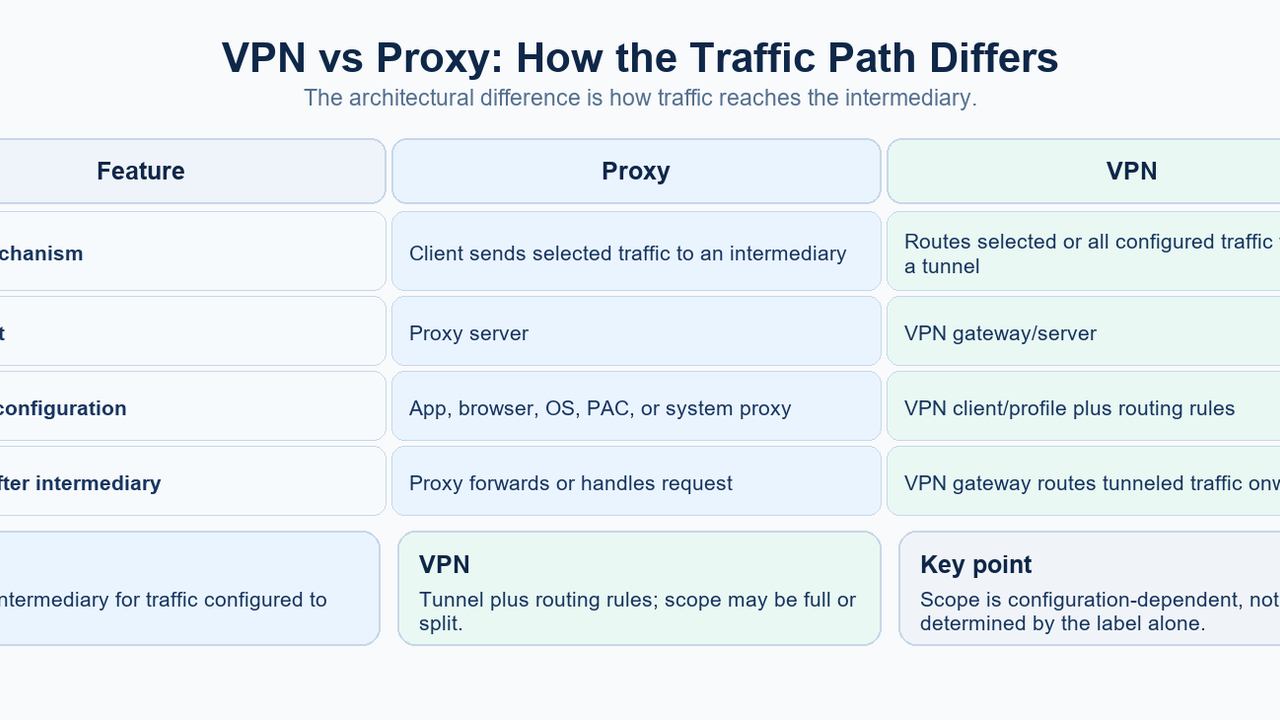
A VPN and a proxy server can both place an intermediary between your device and an Internet destination, but they do it in different ways.
A proxy is an intermediary that traffic is explicitly sent to. A VPN creates a virtual network connection or tunnel and then routes selected traffic through that tunnel.
That difference affects:
- what traffic is covered;
- where encryption applies;
- how routing is controlled;
- how applications interact with the intermediary;
- what performance overhead is added;
- which use cases each architecture fits.
The common summary—“VPNs cover your whole device, proxies cover one app”—is useful as a rough starting point, but it is not a universal rule. VPNs can use split tunneling, while operating systems can expose system-level proxy settings.
The more accurate question is:
Do you need a network tunnel, or do you need an application/network intermediary?
Quick Answer
A proxy server receives traffic from a client and handles or forwards requests on the client's behalf.
A VPN creates a virtual connection to a VPN gateway using tunneling protocols and routing rules.
In practical terms:
- a proxy is usually better suited to explicit application routing, caching, controlled egress, testing, or policy;
- a VPN is usually better suited to protected remote access and network-level tunneling;
- a VPN does not necessarily route every connection because split tunneling can send only selected routes through the tunnel;
- a proxy is not necessarily limited to one browser because systems such as Windows expose broader proxy settings;
- a VPN commonly adds encryption/security controls to the tunnel, while the word “proxy” alone does not imply an encrypted client-to-proxy link;
- neither guarantees anonymity;
- there is no universal speed winner.
What Is a Proxy Server?
MDN's proxy server definition describes a proxy as an intermediary program or computer used between networks.
For a typical forward proxy:
client → proxy → destination
The client sends supported traffic to the proxy. The proxy may:
- forward the request;
- apply policy;
- authenticate the client;
- modify selected request information;
- answer from cache;
- reject the request;
- route it elsewhere.
A proxy therefore operates as an explicit intermediary for traffic that uses it.
That traffic scope depends on the configuration.
A proxy might be configured:
- inside one browser;
- inside one application;
- through environment variables;
- through a PAC/setup script;
- at the operating-system level.
Microsoft's Windows proxy guide, for example, documents system proxy settings for Wi-Fi or Ethernet and supports automatic detection, setup scripts, and manual server/port configuration.
So “proxy = one application only” is not a safe universal definition.
What Is a VPN?
A virtual private network creates a logical network connection across another network such as the Internet.
Microsoft's VPN connection-type documentation describes VPNs as point-to-point connections that use tunneling protocols between a VPN client and VPN server.
NIST's VPN definition similarly describes virtual networks built over existing networks using tunneling and security controls, often including encryption.
A simplified remote-access path looks like:
device → VPN tunnel → VPN gateway → destination
The operating system or VPN client decides which routes enter the tunnel.
That last point matters.
A VPN is not defined by “every packet on the device must go through it.” The routing policy determines the actual scope.
VPN vs Proxy: The Core Architectural Difference
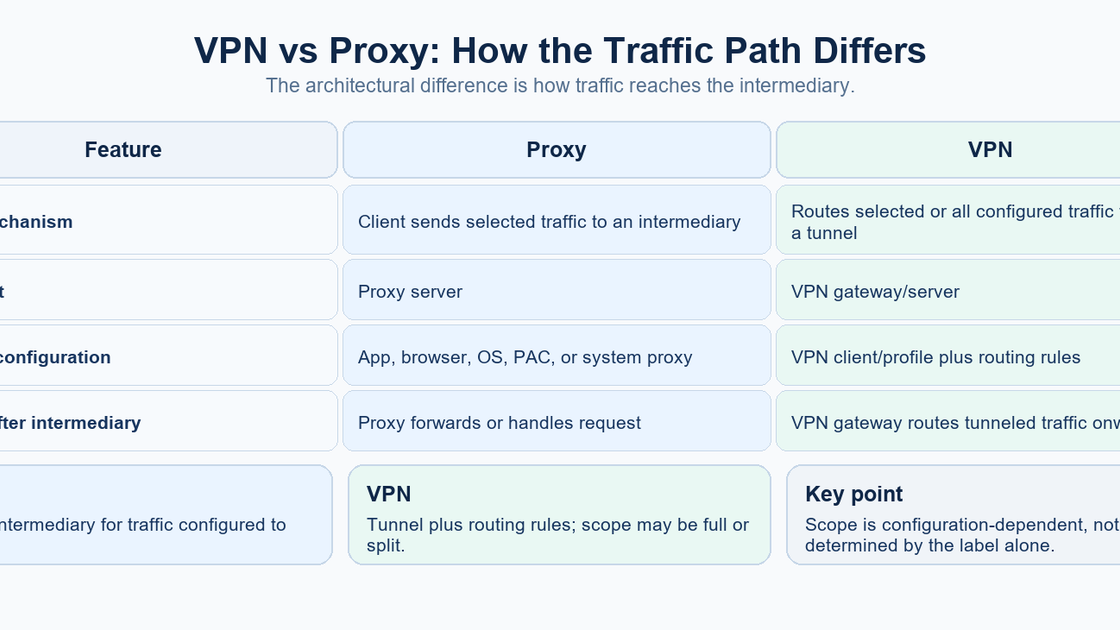
The core difference is not simply “security” or “IP changing.”
It is the way traffic reaches the intermediary.
Proxy model
An application or system configuration tells eligible traffic to use a proxy endpoint.
application → proxy server → destination
The proxy participates directly in the request path.
VPN model
The VPN client establishes a virtual point-to-point connection to a VPN gateway.
device
↓
VPN tunnel
↓
VPN gateway
↓
destination
Routing rules determine which traffic enters that tunnel.
This means a VPN is fundamentally a tunnel-and-routing architecture, while a proxy is fundamentally an intermediary architecture.
Both can change the network path. Both can expose an intermediary-side IP to destinations. But they solve different architectural problems.
Traffic Scope: System-Wide vs App-Level Is Not a Hard Rule
Many VPN-vs-proxy comparisons say:
VPN = all device traffic
Proxy = one application
That pattern exists, but it is too categorical.
VPNs can use split tunneling
Microsoft's VPN routing documentation distinguishes:
- force tunnel — traffic is routed through the VPN according to the full-tunnel policy;
- split tunnel — only configured routes use the VPN while other traffic uses the normal physical interface.
So a VPN can intentionally cover only part of the device's traffic.
Proxies can be configured beyond one app
Windows exposes proxy settings at the system network layer.
A browser or application can also have its own independent proxy configuration.
Therefore the actual scope can look like:
browser-only proxy
application-specific proxy
system proxy
split-tunnel VPN
force-tunnel VPN
The better distinction is:
Proxy scope follows which applications or system components honor the proxy configuration. VPN scope follows routing policy into the tunnel.
Security and Encryption
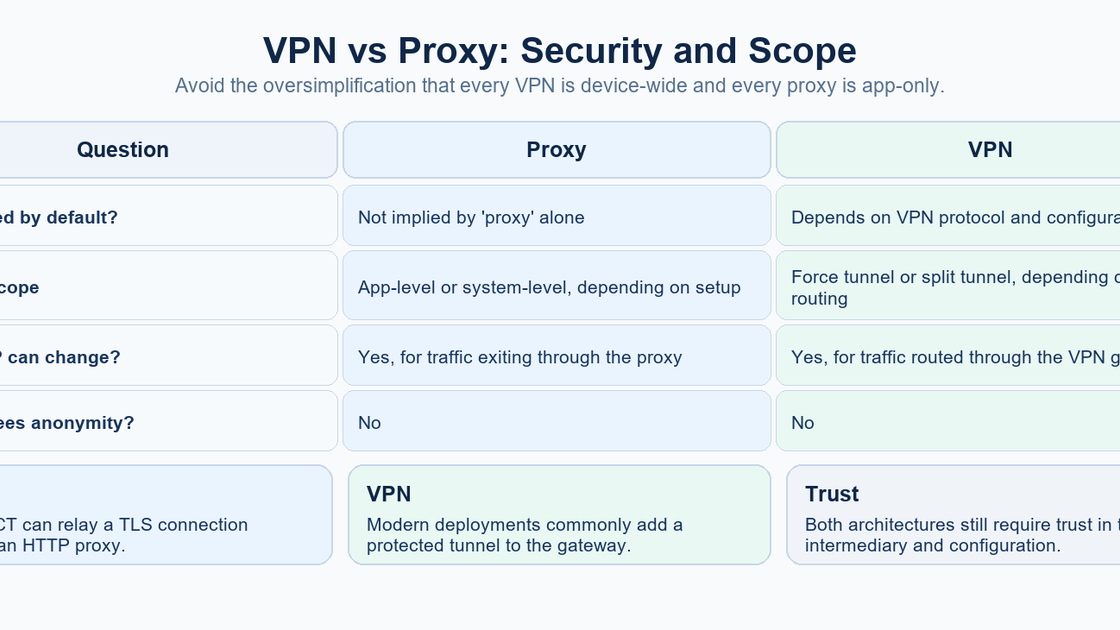
This is the area where VPNs and proxies are most often oversimplified.
VPN security model
NIST describes VPNs as virtual networks that can provide secure communication mechanisms over existing networks. NIST's remote-access VPN guidance also describes VPN connections as adding an encryption layer between remote devices and the organizational network.
That makes a VPN appropriate when the required security boundary is:
device ↔ VPN gateway
However, “VPN” is still not a magic security label.
Security depends on:
- tunneling protocol;
- cryptographic configuration;
- authentication;
- client implementation;
- routing policy;
- DNS behavior;
- endpoint security;
- trust in the VPN operator.
Proxy security model
The word “proxy” alone does not specify whether the client-to-proxy connection is encrypted.
An ordinary HTTP proxy and a TLS-protected proxy connection are not equivalent.
There is another important nuance: HTTPS traffic can remain protected by TLS while passing through an HTTP proxy.
MDN's CONNECT documentation explains that a client can ask a proxy to establish a tunnel to a destination host and port. The proxy then relays data in both directions.
Conceptually:
client → proxy → CONNECT destination:443 → TLS session to destination
So the accurate comparison is not:
VPN encrypts; proxy does not.
It is:
VPN architecture normally defines a protected tunnel to a VPN gateway. Proxy encryption depends on the proxy protocol and connection design, while HTTPS/TLS can remain protected through a proxy tunnel.
IP Address and Privacy
Both architectures can cause a destination to see an intermediary-side public IP.
With a forward proxy:
client → proxy → website
the website normally sees the proxy-side address as its network peer. A proxy can separately forward client-IP information in a header such as X-Forwarded-For, as MDN's X-Forwarded-For reference explains; that header is neither always present nor inherently trustworthy.
With a remote-access VPN:
client → VPN gateway → website
for traffic that actually exits through the VPN gateway, the website normally sees the gateway's egress address, as Cloudflare's VPN overview describes.
But changing the visible network address is not the same as becoming anonymous. Cookies and session IDs can preserve application-level identity across requests, and signing in to an account can directly associate activity with that account.
So neither tool should be described as an anonymity guarantee.
Speed and Performance
There is no universal answer to “Is a VPN faster than a proxy?”
Performance depends on the actual path and implementation.
Important variables include:
- geographic distance to the proxy or VPN gateway;
- server load;
- routing quality;
- protocol overhead;
- encryption/decryption work;
- congestion;
- connection reuse;
- the underlying network;
- whether all traffic or only selected traffic is routed through the intermediary.
A proxy may have less tunnel-related overhead in some configurations.
A VPN may have highly optimized transport and infrastructure and outperform a poorly located or overloaded proxy.
A split-tunnel VPN can also leave unrelated traffic on the normal network path, while a system proxy may affect many applications.
That is why a generic statement such as:
proxy is faster
or:
VPN is faster
is not technically reliable.
The correct comparison is between two specific configurations under the same workload.
VPN vs Proxy Use Cases
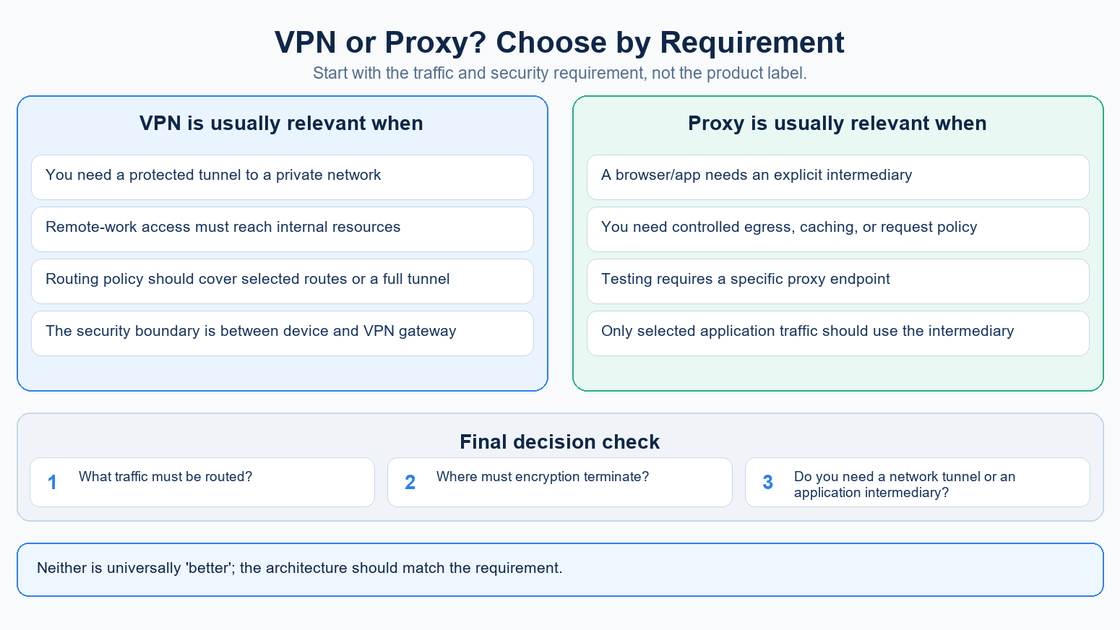
The right choice depends on what problem you are solving.
Use a VPN architecture when the requirement is protected remote access
A VPN is usually the relevant architecture when a remote device needs a protected connection to an organization's private network.
Microsoft's VPN connection guide describes work and personal VPN profiles, including connecting securely from locations such as public networks.
Typical cases include:
- remote employee access;
- access to internal organizational services;
- a protected tunnel across an untrusted local network;
- network routes that should enter a corporate gateway;
- centrally managed remote-access policies.
Use a proxy architecture when the requirement is an explicit intermediary
A proxy is usually the relevant architecture when an application or system needs traffic to pass through a specific intermediary.
Typical legitimate uses include:
- application testing;
- controlled outbound egress;
- network policy;
- caching;
- browser or application routing;
- monitoring;
- debugging;
- public-data workflows where authorization, terms, and request policies are independently respected.
Use architecture, not branding, to decide
If the real requirement is:
“This browser or application needs to use a specific intermediary.”
that points toward a proxy.
If the requirement is:
“These routes need a protected network tunnel to a gateway.”
that points toward a VPN.
Can You Use a VPN and Proxy Together?
Yes.
The two layers are not mutually exclusive.
Microsoft's Windows proxy guide explicitly documents separate proxy settings for a VPN connection.
That can produce a layered design where VPN routing and proxy policy coexist.
But stacking both does not automatically improve security or privacy.
It can also:
- increase latency;
- complicate DNS and routing;
- create troubleshooting problems;
- make it less obvious which intermediary sees which traffic.
Use both only when the architecture requires both layers.
VPN vs Proxy Comparison Table
Feature | Proxy | VPN |
|---|---|---|
Core architecture | Explicit intermediary | Virtual tunnel + routing |
Typical endpoint | Proxy server | VPN gateway/server |
Traffic scope | App-specific or system-level | Split tunnel or force tunnel |
Encryption | Depends on proxy protocol and connection | Commonly part of the VPN security design |
HTTPS support | Can tunnel TLS with CONNECT | HTTPS travels inside the routed VPN path |
Public IP seen by destination | Can be proxy-side IP | Can be VPN egress IP |
Guarantees anonymity | No | No |
Typical enterprise role | Egress control, caching, app routing | Secure remote access, private-network connectivity |
Performance | Implementation-dependent | Implementation-dependent |
Can be combined | Yes | Yes |
FAQ
What is a VPN vs proxy in simple terms?
A proxy is an intermediary that selected traffic is configured to use. A VPN establishes a virtual tunnel to a VPN gateway and routes selected network traffic through it.
Is a VPN the same as a proxy?
No. They can both alter the traffic path and visible public IP, but the architecture is different. A proxy is an intermediary endpoint; a VPN creates a tunneled network connection.
Does a VPN route all traffic?
Not necessarily. A VPN can use force tunneling or split tunneling. In a split-tunnel configuration, only selected routes enter the VPN.
Is a proxy only for one app?
Not necessarily. Some proxies are configured per application, but operating systems can also expose broader system proxy settings.
Which is more secure, a VPN or proxy?
The answer depends on the exact implementation. VPN architecture is designed around tunneling and security controls and commonly protects the connection to the VPN gateway. A generic proxy does not inherently provide that same security boundary. But protocol, authentication, encryption, routing, and provider trust still matter.
Does a proxy encrypt traffic?
Not automatically. Encryption depends on the proxy protocol and connection. HTTPS can still use TLS through an HTTP proxy tunnel created with CONNECT.
Does a VPN hide your IP address?
For Internet traffic routed through a remote VPN gateway, destinations commonly see the VPN-side egress address rather than the client's direct public address. That does not guarantee anonymity.
Does a proxy hide your IP address?
A forward proxy can present its own network address to destinations for proxied requests, though it may separately forward client-IP information in headers. Cookies, session IDs, and account logins can still associate requests with the same user.
Is a VPN faster than a proxy?
There is no universal winner. Server distance, congestion, routing, protocol overhead, encryption, provider infrastructure, and traffic scope can matter more than the label.
Can I use a VPN and proxy at the same time?
Yes. Windows even supports separate proxy settings for a VPN connection. Use both only when the network architecture requires both layers.
Which should I use for remote work?
If the goal is protected access to an organization's internal network, a managed VPN is the typical architecture.
Which should I use for application-specific routing or testing?
A proxy is usually the more direct architecture when selected application traffic needs a specific intermediary.
Final Takeaway
The most useful distinction between a VPN and a proxy is architectural:
Proxy = intermediary
VPN = tunnel + routing
From there, the other differences make more sense.
A VPN commonly establishes a protected connection to a VPN gateway, but its scope can be force tunnel or split tunnel.
A proxy can be configured inside one application or at a broader system level, and its encryption properties depend on the proxy protocol and connection design.
Both can change the public IP visible to a destination. Neither guarantees anonymity. Neither is universally faster.
Choose based on the actual requirement:
Need a protected network tunnel? → VPN
Need an explicit intermediary for selected traffic? → Proxy
That distinction is more accurate—and more useful—than treating either technology as universally better.
Explore more proxy insights
Sources
- MDN's proxy server definition
- Microsoft's Windows proxy guide
- Microsoft's VPN connection-type documentation
- NIST's VPN definition
- Microsoft's VPN routing documentation
- NIST's remote-access VPN guidance
- MDN's CONNECT documentation
- MDN's X-Forwarded-For reference
- Cloudflare's VPN overview
- Cookies and session IDs
- Microsoft's VPN connection guide