
Smart proxy routing is the policy layer that chooses how a permitted request reaches its destination through available proxy exits. Instead of treating every request identically, a router can consider the required location, session continuity, endpoint health and cost. “Smart” describes those decisions; it is not a standardized protocol or a guarantee of successful access.
A useful design separates three questions: which exits are eligible, which eligible exit should be selected, and what happens if the request fails. This separation makes the system easier to explain and debug. A proxy provider supplies network resources and supported controls; your application or gateway may still need to implement the decision logic.
The routing layer in context
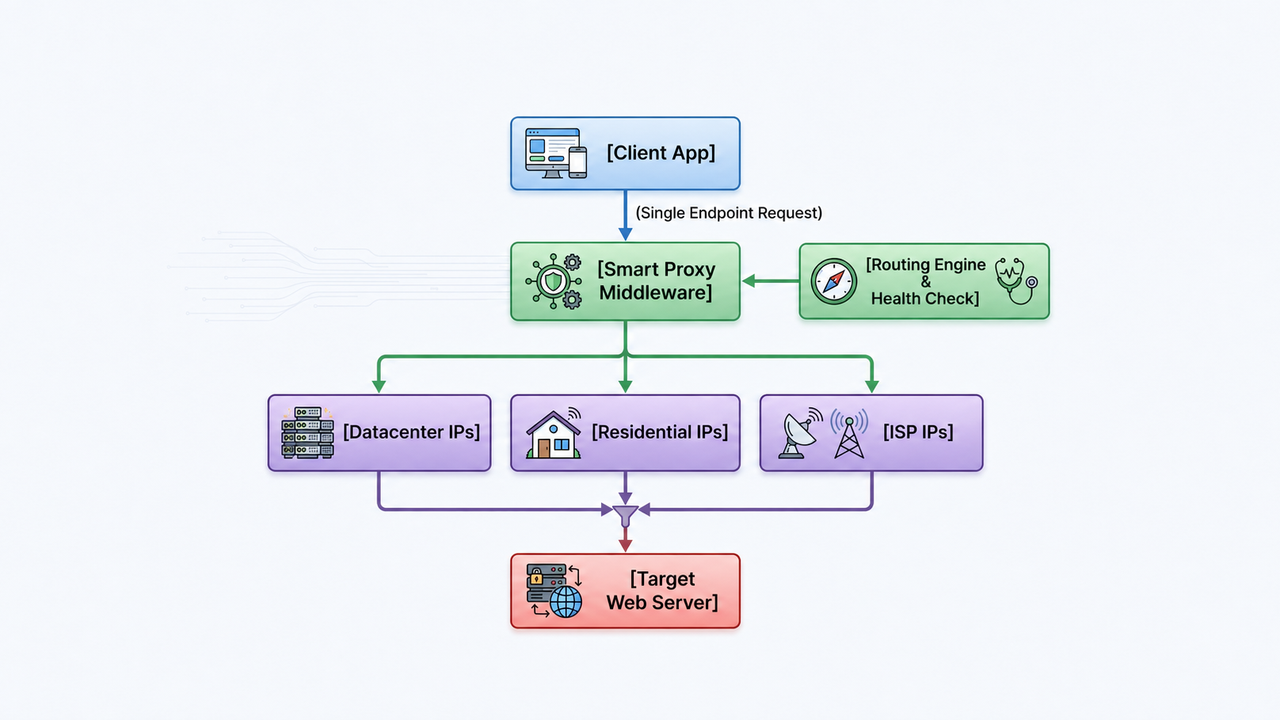
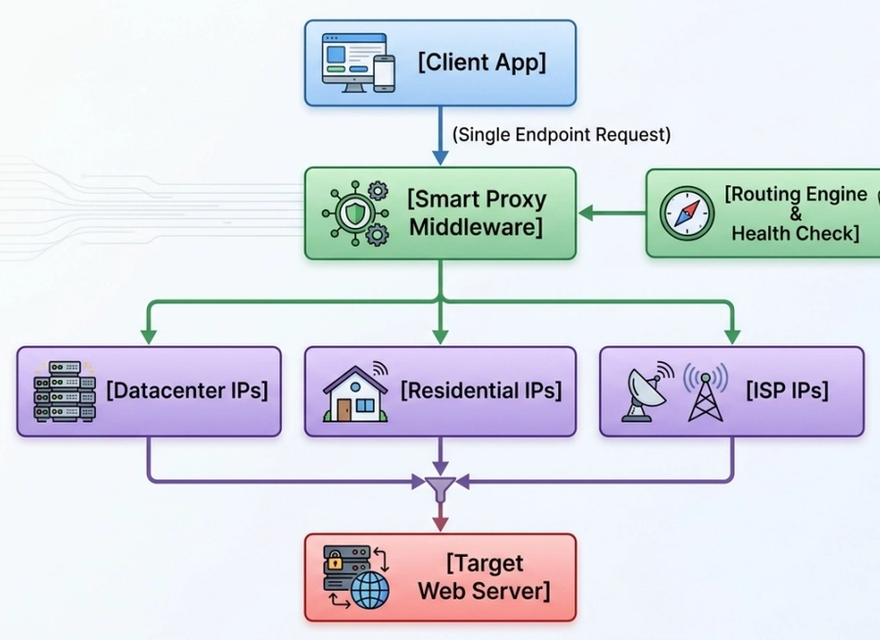
The client submits a request to a routing layer, which selects an eligible proxy exit before connecting to the destination. Read this as a conceptual architecture: the diagram does not assert that every decision or recovery mechanism is built into a MIYAIP product.
The components of a routing system
Request context and policy
Start with constraints the application actually knows: an allowed target, required country, whether the request belongs to a logged-in session, and whether it can be safely repeated. An explicit constraint is more useful than a vague goal such as “maximize success.” If a country is mandatory, silently falling back to another country is an incorrect result even when the server returns HTTP 200.
Eligible exits and selection
Filter the available pool by those constraints before balancing load. Selection can then use simple rules such as a stable session assignment or a weighted choice among healthy endpoints. Latency measurements can help, but a fast proxy that cannot meet the required location or session rules is not eligible. Keep the first version understandable enough to diagnose from logs.
Connection handling and observations
Record enough information to distinguish a local connection error, proxy authentication failure, upstream response and application-level validation problem. A returned page can be an error page even when transport succeeded. Measure accepted results separately from connection success, and avoid logging passwords, cookies, access tokens or sensitive response bodies.
Rotation and sticky sessions solve different problems
Rotation changes the exit assignment according to the supported product settings. A sticky session aims to retain an exit for a supported period or session arrangement. Neither should be treated as permanent identity: network resources can become unavailable, and the destination may associate a session with more than an IP address.
For an authenticated workflow, changing IP midway through a session can introduce another variable during troubleshooting. A stable exit is often easier to reason about. For independent, authorized requests, controlled rotation may be appropriate. The policy should follow the task’s requirements, not a blanket rule that more rotation always improves results.
If a selected region has no suitable exit, return an explicit unavailable result or use a fallback the application has allowed in advance. Do not claim precise location beyond the product’s available pool or the destination’s own interpretation of IP geolocation.
Handle failures by category
Observed signal | What to investigate | Appropriate response |
|---|---|---|
Connection or DNS failure | Client configuration, endpoint reachability and resolver behavior | Check the connection path; retry within a bounded policy |
HTTP 407 | Proxy authentication or credentials | Correct authentication before sending more traffic |
HTTP 403 | Destination refusal, permissions or policy | Inspect the response and access rights; do not assume an IP-only issue |
HTTP 429 | Rate limiting associated with the service’s chosen identity | Reduce or stop work; honor Retry-After when supplied |
Interrupted state-changing request | Whether the server already applied the action | Reconcile the outcome before retrying |
These status meanings come from HTTP Semantics and the 429 specification. They do not define any Instagram-specific quota. A 429 can be associated with an account or another identifier, so selecting another exit may leave the actual limit unchanged.
Failover needs a retry budget
Define a maximum attempt count, an overall deadline and a delay policy. Retry only when the failure and request semantics justify it. Repeating a read and repeating a purchase, form submission or content publication have different consequences. For state-changing operations, use a supported idempotency mechanism or check whether the first attempt succeeded before trying again.
A router cannot promise seamless recovery after every connection interruption. Once a response has started flowing to the client, replay may no longer be transparent. NGINX’s upstream retry documentation illustrates such constraints; a reverse-proxy configuration is also not automatically a forward-proxy pool implementation.
What the proxy can see
For an HTTPS connection carried through an HTTP CONNECT tunnel without TLS termination, the proxy relays encrypted bytes rather than rewriting the application’s encrypted HTTP headers. Claims that any ordinary proxy automatically normalizes browser TLS behavior or removes all identifying headers are misleading. SOCKS5 is a transport proxy protocol, not encryption by itself.
MIYAIP capabilities and your implementation boundary
Layer | Verified product capability or responsibility |
|---|---|
MIYAIP dynamic residential resources | Rotating or sticky sessions; location selection subject to pool availability |
MIYAIP static residential resources | Fixed dedicated exit IPs for workflows needing stable routing |
Connection configuration | Supported HTTP(S)/SOCKS5 settings and dashboard-issued endpoints and credentials |
Your application or gateway | Target allowlists, request budgets, session policy, health scoring, safe retries and result validation |
The dynamic residential product page and static residential product page describe the available resource types. This article does not claim a built-in MIYAIP feature that automatically classifies every failure, rewrites TLS fingerprints or bypasses platform restrictions. Use the generated configuration rather than copying an unverified endpoint from an article.
Before scaling, test a small authorized workload and inspect effective location, session behavior, usable-result rate and total cost. The residential proxy comparison helps choose a resource type; the static proxy tutorial covers setup.
Frequently asked questions
Is smart routing the same as IP rotation?
No. Rotation is one selection behavior. Routing also covers constraints, session assignments, failure handling and observations.
Will failover preserve a logged-in session?
Not necessarily. Cookies and application state may remain, but a new exit can change how the destination assesses the session. Re-authentication or manual review may be needed.
Should every 403 trigger a new proxy?
No. A refusal may concern permissions or account policy. Classify the response before changing the network path.
Does MIYAIP implement the entire architecture shown here?
The diagram explains a general design. MIYAIP provides documented proxy resources and controls; application-specific routing and recovery logic must be verified or implemented separately.
Choose exits that match your routing policy
Compare MIYAIP residential resources, then validate session and location behavior with a small permitted workload.
Sources
Technical references are linked next to the relevant behavior. Additional protocol reference: SOCKS Protocol Version 5, RFC 1928. Product and standards sources reviewed September 5, 2026. No comparative performance benchmark is claimed.