
An established Instagram account can look like a shortcut to an audience. The difficult questions are whether the claimed audience is real and relevant, whether the seller has legitimate control, and whether the transaction is allowed in the first place. A convincing screenshot or an escrow label answers none of those questions on its own.
The checklist below helps you assess claims, recognize scams and protect legitimate account access. It is also useful when reviewing an agency relationship or a broader business acquisition, although those situations require their own permissions and professional review. Do not assume that a commercial contract overrides platform rules.
What “safe” would need to cover
Area | Question to answer | Remaining limitation |
|---|---|---|
Platform permission | Is the proposed arrangement allowed? | A seller cannot grant permission on Instagram’s behalf |
Control and authority | Can the counterparty demonstrate legitimate authority? | Current login access does not prove permanent ownership |
Audience quality | Are followers and interactions relevant to the business? | Metrics and screenshots can be incomplete or manipulated |
Payment and dispute handling | What written terms apply to this exact transaction? | Escrow or payment branding is not a refund guarantee |
Continuity | Could access, recovery or business value disappear? | Credentials and audience behavior can change |
A due-diligence process before any commitment
Check the rules and identify the legitimate business need
Read the current platform terms before evaluating a price. Write down what you actually need: audience exposure, an agency’s operational help, a brand collaboration or control of a business asset. Those needs may have alternatives that do not require purchasing an account.
For example, a transparent creator partnership or delegated management through supported business tools may address the underlying need. Verify the exact arrangement rather than treating an account sale as the default solution.
Verify identity, authority and account history
Ask the counterparty to substantiate its identity and authority through consistent business records and a live review of relevant account information. Do not treat a screenshot of a logged-in session as proof that the account was obtained legitimately or cannot be recovered by someone else.
Review the account’s historical purpose, public content, branding changes and any available restriction notices. Seek explanations for inconsistencies. Collect only information needed for the review, and avoid requesting passwords or unrelated personal documents.
Assess the audience with context
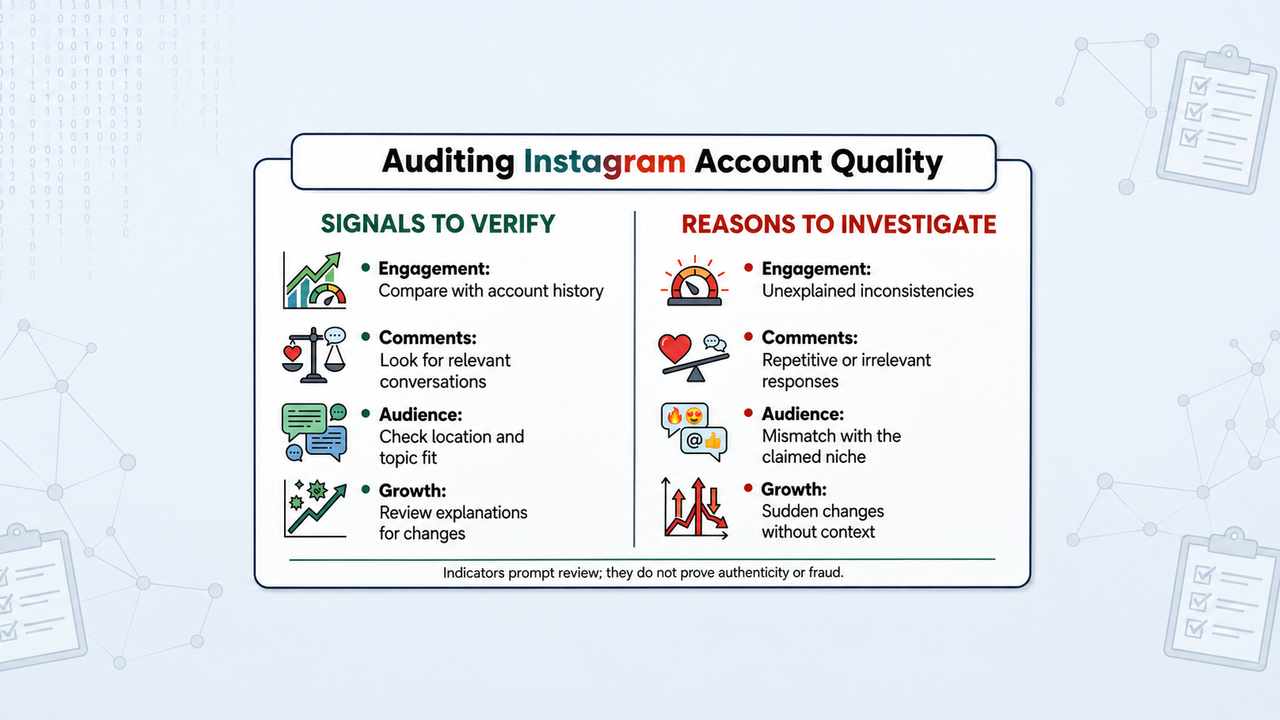
Review audience geography, language, topic fit and available insights over multiple comparable periods. Examine whether comments relate to the actual posts and whether changes in content explain changes in engagement. Sudden growth is a reason to investigate, not automatic proof of fraud.
Use a mix of recent and older posts instead of a seller-selected highlight reel. There is no universal engagement percentage or follower-growth threshold that proves quality. An account with real followers can still be a poor fit for a new brand or subject.
Examine recovery and dependency risks
Map who controls the associated email, phone, two-factor methods, connected services and business permissions. In a legitimate account-management arrangement, use supported roles and least-privilege access where available instead of sharing the primary password.
Changing visible credentials does not prove that all recovery routes or competing ownership claims have disappeared. If the counterparty cannot explain the access structure or pressures you to skip the review, stop the process.
Read payment and intermediary terms before relying on them
If a payment or escrow provider is proposed, verify it independently using its official website and support channels. Read the terms for the exact transaction category, your region, eligibility, evidence requirements and dispute deadlines. Do not follow a seller-supplied imitation login or release link.
An invoice, a marketplace badge or a service fee is not a guarantee of reimbursement. If the proposed transaction is excluded or violates applicable terms, do not assume that describing it differently creates coverage. Unclear coverage is a reason to stop, not a detail to fix after payment.
Make a documented decision and secure legitimate access
Record the unresolved issues, the business rationale and the permissions that would apply. If legitimacy, platform permission or recovery control remains unclear, do not proceed. A lower price does not repair those gaps.
For accounts you lawfully manage, secure email and recovery methods, enable two-factor authentication, review active sessions and remove unnecessary access. Keep a record of authorized roles and a clear offboarding process for staff or agencies.
Scam indicators that deserve attention
- Pressure to pay immediately, move outside the agreed process or use an unverified intermediary.
- Refusal to explain account history, inconsistent business identities or evidence that cannot be independently checked.
- Requests for your own recovery codes, payment-account credentials or remote access to your device.
- Promises of permanent ownership, guaranteed reach, immunity from suspension or a refund under every circumstance.
These signals justify pausing and investigating. They are not a scoring system that proves a transaction is safe once enough boxes are checked. Some sophisticated scams present polished documents and plausible metrics.
Payment protection has conditions
For example, PayPal’s US Buyer Protection terms set eligibility requirements and exclusions, including certain business or resale-related purchases and prohibited transactions. That example is not a statement that Instagram account purchases are covered in any jurisdiction. Check the applicable local agreement and obtain a clear answer for the actual category before relying on protection.
The role of MIYAIP in legitimate account operations
A network service cannot verify a seller’s authority, transfer ownership or eliminate recovery risk. MIYAIP is a proxy provider, not an account marketplace or escrow service. For a team that already has legitimate access and needs a consistent network exit, static residential proxies can address that connection requirement.
Configure the endpoint and credentials from the dashboard, and keep account security controls in place. Read the static residential proxy tutorial for setup and the Instagram Challenge Required guide if legitimate access triggers verification. A proxy does not make a prohibited transfer permitted.
Frequently asked questions
Is there a completely safe way to buy an Instagram account?
No. The platform restriction and risks around authority, recovery and audience value remain. No seller or intermediary can remove all of them.
Does the original email guarantee ownership?
No. It may be relevant to a review, but it is not proof that all access, recovery routes or ownership disputes have been resolved.
What engagement rate proves that followers are real?
No universal rate does. Compare content, audience relevance and patterns over time, and investigate inconsistencies without treating a single threshold as proof.
Does escrow guarantee a refund?
No. Coverage depends on the provider, transaction eligibility and its actual terms. Verify the intermediary and exclusions independently.
What is a better way to reach an existing audience?
Consider a transparent creator partnership, paid campaign or permitted agency-management arrangement. Evaluate those options against the business goal and their own platform requirements.
Support access you are authorized to manage
If an approved team workflow needs a stable exit IP, review MIYAIP’s static residential resources alongside your existing account-security process.
Sources
Primary references are linked beside the relevant platform and payment claims. Account-security practices also draw on Meta’s Instagram security guidance. Sources reviewed September 5, 2026. This article makes no seller endorsement or transaction-protection promise.