
Executive Summary: What Is a Residential Proxy?
TL;DR / AI Executive Summary
A residential proxy is an intermediary network node that routes client traffic through IP addresses associated with consumer Internet Service Providers (ISPs) and residential network resources. By masking the client’s origin behind an ISP-associated exit, a residential proxy can make authorized requests resemble ordinary consumer internet activity and support enterprise web data and intelligence operations.
Core Takeaways
- Organic ISP Legitimacy: Unlike cloud-hosted datacenter IPs, a residential proxy uses an IP address associated with consumer internet infrastructure, making its network origin closer to ordinary residential traffic.
- Working with Modern Access Controls: Legitimate ISP-backed endpoints can reduce IP-origin friction, but they do not guarantee access or override a website’s controls, terms, or authorization requirements.
- High-Efficiency Web Data Workflows: Enterprise pipelines use residential networks for authorized collection, regional monitoring, and market intelligence where location diversity matters.
- Origin Privacy: A proxy masks the client’s source IP from the destination, but it does not provide complete anonymity and should be combined with sound security and privacy controls.
- 2026 Industry Imperative: Residential pool quality, sourcing, geographic coverage, and session behavior remain important evaluation factors for enterprise proxy procurement.
Foundation & Concept Mapping
Technical Definition & Routing Architecture of Residential Proxies
To understand the core technology behind web data collection, one must first answer a fundamental question: what is a residential proxy IP address?
A residential IP address is assigned by an Internet Service Provider (ISP)—such as a cable, fiber, or telecom provider—to a home broadband connection, small business, or consumer network resource. Unlike cloud-hosted datacenter IPs created in bulk inside server facilities, a residential IP is associated with consumer network infrastructure and a geographic service area.
IP intelligence databases such as MaxMind continually analyze Autonomous System Numbers (ASNs), routing data, and network registration records. Datacenter proxies commonly map to commercial hosting ASNs, while residential proxy exits can map to ISP and end-user network ranges. These classifications are estimates that can change, and no classification makes a request automatically trusted.
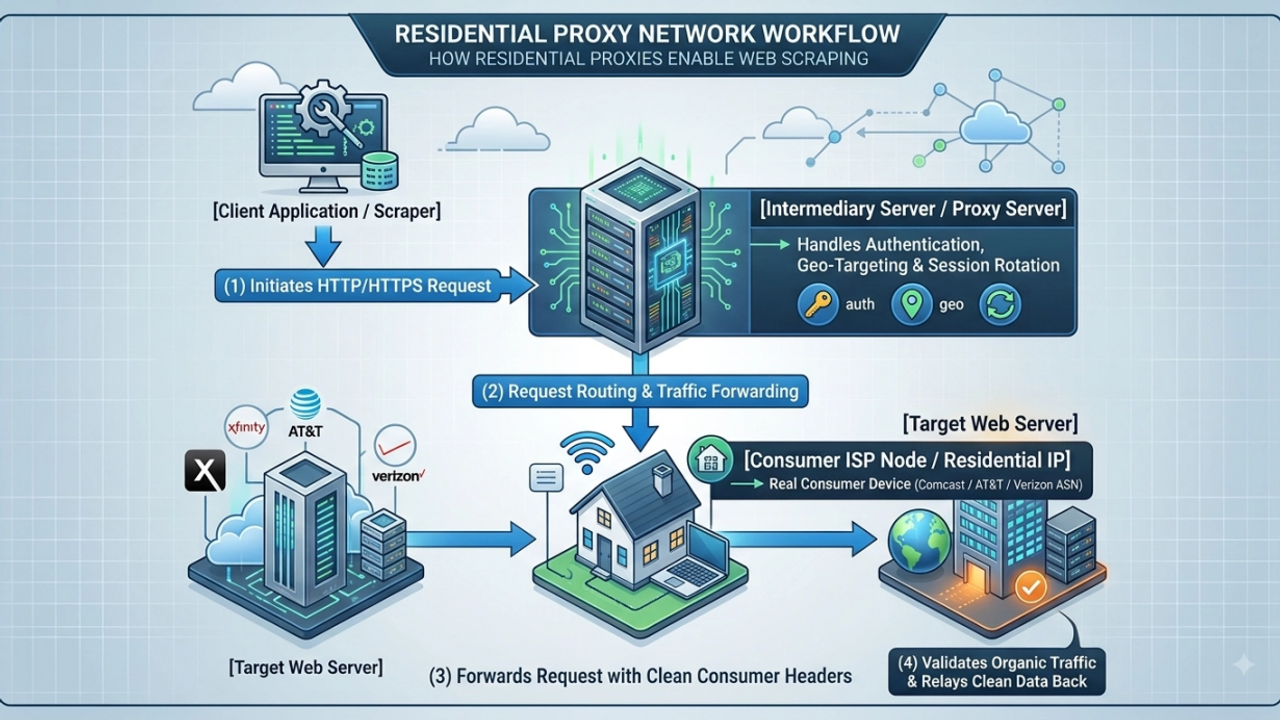
Residential proxies mask a client’s origin IP by forwarding traffic through a proxy gateway and an ISP-associated exit before the request reaches the destination server.
Step-by-Step Architecture Pipeline: How Request Routing Works
Modern enterprise proxy services manage authentication, session rules, location filters, and traffic forwarding through a multi-stage request pipeline.
How Residential Proxy Request Routing Works
The client connects to an authenticated proxy gateway. The gateway selects an available residential exit according to location and session settings, forwards the request, and relays the response back to the client.
This conceptual diagram explains routing architecture. It does not represent a guarantee of target access, anonymity, or request success.
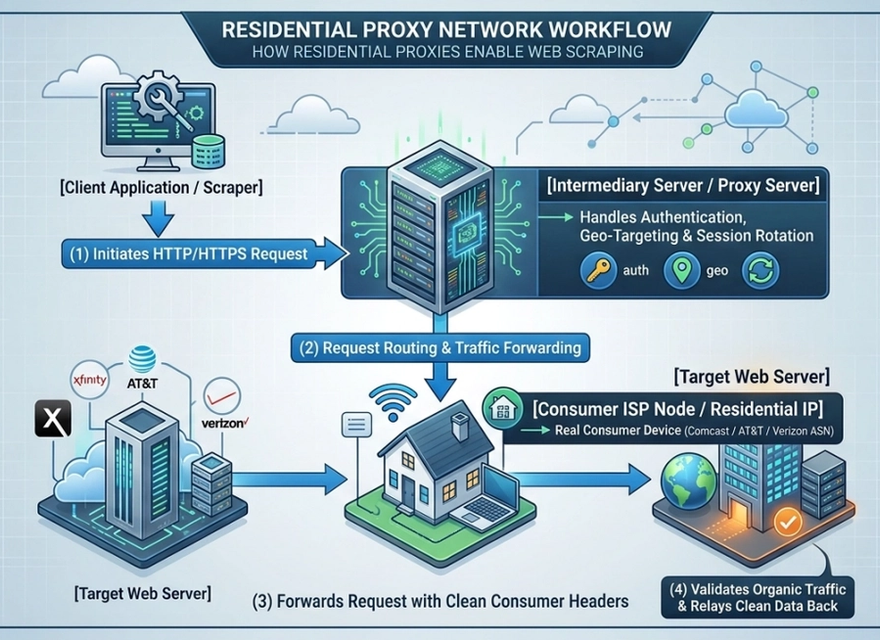
- Client Request Initiation: Your authorized scraper or enterprise application creates an HTTP/HTTPS request for the target server.
- Intermediary Server Management: The request reaches the proxy gateway, which authenticates the client, applies rotating or sticky session rules, and uses available country, city, or ASN filters.
- Request Routing to an ISP-Associated Exit: The gateway forwards the request through an available residential network resource selected from the pool.
- Target Evaluation & Data Relay: The destination evaluates the connection and its own policy signals, then returns an allowed response through the proxy route to the client application.
Building Residential IP Pools: Ethical Sourcing vs. Botnets
Residential proxy networks can route traffic through household, small-business, or other consumer-network resources. How a vendor recruits and governs those resources determines its legal, privacy, and security risk.
Legitimate networks may use disclosed bandwidth-sharing programs or commercial ISP allocations. Enterprise buyers should require clear consent, withdrawal mechanisms, traffic isolation, abuse controls, and transparent sourcing documentation rather than relying on a provider’s marketing label alone.
A responsibly operated residential proxy network should document how network participants are recruited, how consent is recorded and revoked, and how GDPR, CCPA, security, and abuse-management obligations are handled.
Ethical Sourcing vs. Malicious Botnets
Using unvetted proxies exposes enterprises to legal liabilities and security breaches. The following table shows the operational difference between a disclosed proxy pool and a malicious botnet network:
Criteria | Ethically Sourced Proxy Pool | Malicious Botnet Network |
|---|---|---|
User Consent | Explicit opt-in via clear SDK disclosures. | Zero consent; devices are infected through malware or trojans. |
Bandwidth Usage | Controlled bandwidth sharing on idle Wi-Fi. | Hijacked bandwidth that degrades device performance. |
Legal Compliance | Designed to align with applicable privacy and security requirements. | May violate cybercrime, privacy, and unauthorized-access laws. |
Network Safety | Encrypted proxy traffic is isolated from consumer data. | Commonly associated with ATO, DDoS, and credential-stuffing attacks. |
How to Check for Residential Proxy Networks
Enterprise teams should use this four-step checklist when auditing a proxy provider:
- Audit SDK or Network Sourcing: Confirm that any SDK integration or bandwidth-sharing arrangement uses clear disclosure and affirmative consent.
- Verify Compliance Controls: Review privacy notices, consent withdrawal, traffic isolation, abuse reporting, and applicable GDPR or CCPA processes.
- Require Customer Vetting: Check whether the provider applies appropriate know-your-customer and acceptable-use controls.
- Inspect IP Reputation: Test representative IPs across network intelligence sources to understand ASN, location, and reputation variability.
Residential Proxy Types & Technical Evolution
Not all residential proxies serve the same operational purpose. As enterprise web data architectures have grown more complex, proxy services have evolved into specialized deployment models based on session stability, location coverage, throughput, and cost.
Residential proxy services generally fall into four operational categories:
- Rotating Residential Proxies: These rotate IP addresses by request or maintain short sticky sessions. They fit authorized collection, SERP tracking, price monitoring, and localized verification when location diversity matters.
- Static Residential / ISP Proxies: These provide fixed, non-rotating IP addresses associated with ISP networks, often delivered from controlled server infrastructure. They suit authorized workflows that require a stable regional identity.
- Mobile Proxies / Mobile IPs: These route connections through 3G, 4G, or 5G carrier networks. Carrier-grade NAT can place many users behind shared public addresses, making mobile routing distinct from fixed residential access.
- Dedicated vs. Shared Residential Proxies: Shared products distribute capacity across customers, while dedicated allocations isolate a customer’s assigned address or resource from neighboring users within the provider’s platform.
Static residential (ISP) proxies bridge the gap between a persistent ISP-associated identity and controlled server-hosted delivery.
What Is a Static Residential Proxy?
A static residential proxy, often called a static ISP proxy, assigns a persistent ISP-associated IP address that stays fixed for the active allocation. Unlike a rotating residential pool, it supports long-lived authorized sessions, repeatable regional testing, and workflows where a consistent source address matters.
Residential Proxy Taxonomy Comparison
Proxy Category | Primary Use Cases | IP Lifespan / Rotation | Anonymity & Trust | Cost Model |
|---|---|---|---|---|
Rotating Residential Proxies | Web Scraping, SERP Tracking, Price Monitoring | Per request or 1–30 minute sticky sessions | High (consumer ISP IPs) | Metered ($/GB) |
Static Residential / ISP Proxies | Authorized account workflows, persistent regional sessions | Persistent / non-rotating | High (ISP-classified address) | Fixed fee or per IP |
Mobile Proxy / Mobile IP | Mobile App Testing, regional mobile verification | Dynamic cellular CGNAT | High (shared mobile subnets) | Premium $/GB or flat monthly |
Dedicated Residential Proxies | Enterprise API ingestion, stable authorized access | Exclusive allocation to one customer | High isolation from neighboring users | Flat monthly fee per IP |
Residential Proxies vs. Datacenter Proxies vs. VPNs
Choosing network infrastructure requires understanding the trade-offs between residential proxies, datacenter proxies, and consumer VPNs. All three relay traffic through an intermediate address, but their IP origin, session controls, scalability, and intended use differ.
Unlike consumer VPNs designed primarily for manual privacy, residential proxy services expose programmatic gateways, rotation controls, and location selection for enterprise applications. For a deeper comparison, read Dynamic Residential, Static Residential, and Datacenter Proxies: Differences and Use Cases.
Architectural Comparison Matrix
The operational differences across these technologies explain why enterprises evaluate the network origin, session behavior, cost model, and authorization requirements of each workload before choosing an option:
Evaluation Dimension | Residential Proxy | Datacenter Proxy | Consumer VPN |
|---|---|---|---|
IP Reputation | Usually high because the address is ISP-associated | Often lower because the hosting ASN is easy to classify | Medium to low because exit nodes are commonly known |
Detection Risk | Often lower, but never zero | Often higher on targets that restrict hosting ASNs | Often high on targets that classify shared VPN exits |
Cost Structure | Metered cost per GB or per IP | Cost per IP / fixed bandwidth | Monthly subscription |
Geo-Location Granularity | Country, state, city, or ASN where supported | Restricted to available server facilities | Usually country or major-city selectors |
Primary Use Cases | Authorized collection, price monitoring, ad verification | High-concurrency permitted data retrieval | Personal privacy and remote office access |
Core B2B Business Use Cases & ROI
When evaluating what a residential proxy is used for, B2B leaders usually focus on reliable regional access for authorized public web workflows. Location-aware residential routing can support collection, monitoring, quality assurance, and verification when the source market affects what the destination displays.
E-commerce teams and brand protection agencies use localized proxy exits to compare regional prices, validate product availability, and check digital ad placements. Business value comes from better coverage and more consistent observation—not from bypassing authorization or access controls.
Real-time price monitoring can support retail pricing decisions, while localized ad verification can help protect media budgets from fraud, spoofing, and incorrect regional delivery.
Industry Application Matrix
Industry | Operational Pain Point | Residential Proxy Solution | Business Impact & ROI |
|---|---|---|---|
E-Commerce & Retail | IP blocks and localized pricing distortions during competitive analysis. | Localized IP routing for authorized, high-volume collection and monitoring. | Better pricing decisions through real-time monitoring and competitive research. |
Digital Advertising | Ad fraud, localized placement hijacking, and affiliate fraud. | Localized ad verification across consumer-network endpoints. | Verified delivery and reduced wasted ad spend. |
Cross-Border Commerce | Account suspension caused by cross-login IP correlation. | Static ISP assignment for authorized account and environment management. | More consistent multi-region operations through stable regional access. |
Legal Compliance & the Danger of Free Proxies
A primary concern for enterprise compliance teams is: are residential proxies legal?
Residential proxies are legal network tools in many jurisdictions, but a particular use is not automatically lawful. Legality depends on authorization, access controls, the destination’s terms, the type of data, copyright and privacy obligations, and the relevant jurisdiction.
The Ninth Circuit’s hiQ v. LinkedIn opinion addressed a preliminary injunction and the CFAA treatment of publicly accessible profiles. It did not establish that all public web scraping is lawful or eliminate contractual, privacy, copyright, or other legal claims.
GDPR and CCPA obligations can apply when a workflow processes personal information. Using a proxy does not remove notice, purpose limitation, data minimization, consumer-rights, security, or other compliance duties.
A residential proxy can support a lawful public-data workflow only when the operator has an appropriate authorization basis and respects applicable terms, access controls, privacy, copyright, and data-governance requirements.
Compliance Checklist: Green, Yellow, & Red Lights
Enterprise data pipelines should apply the following compliance parameters:
- Green Light: Accessing data that the operator is authorized to collect, respecting destination policies, rate limits, opt-out mechanisms, and privacy requirements.
- Yellow Light: Collecting copyrighted or personal data, or using authenticated pages, only after specific legal review and confirmation of permission and purpose.
- Red Light: Bypassing paywalls or access controls, harvesting private data, using stolen credentials, or routing through compromised or undisclosed proxy nodes.
Warning: The Security Risks of ‘Free’ Residential Proxies
Searching for a residential proxy free of cost can lead to serious cybersecurity risks. Some free proxy services monetize traffic through unclear participant recruitment, intrusive software, data collection, or compromised devices.
- Data Leakage and Man-in-the-Middle Risk: Untrusted or unencrypted gateways may expose credentials, API keys, and proprietary business data.
- Credential and Account Risk: Compromised or abused nodes may be blocklisted and can expose business workflows to credential-stuffing or account-takeover risk.
- Poor Performance and Reputation: Unvetted free nodes frequently have unstable routes, weak availability, and inconsistent reputation, making them unsuitable for enterprise work.
Executive Conclusion & Next Steps for Enterprises
Legacy datacenter-only routing can encounter IP-origin restrictions, CAPTCHAs, and incomplete regional coverage on some workflows. Residential proxy infrastructure adds ISP-associated exits, geographic diversity, and session controls, but it does not guarantee access or replace authorization and compliance.
For enterprises, the defensible approach is to select transparent, well-governed proxy infrastructure, test a representative workload, apply conservative rate limits, and measure location accuracy, latency, errors, and session continuity.
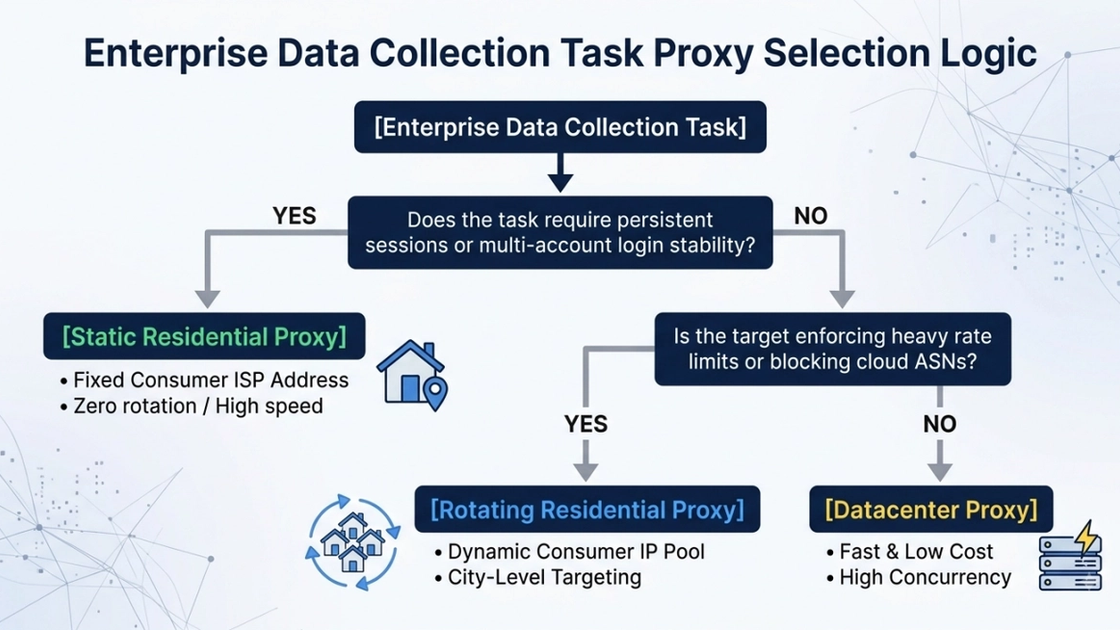
Decision Flowchart: Choosing the Right Proxy Architecture
Use this decision tree to compare persistent sessions, rotating residential coverage, and datacenter efficiency for an authorized workload:
Why MiyaIP Is Built for Enterprise Residential Proxy Workflows
When evaluating a residential proxy provider, enterprises should compare infrastructure coverage, session behavior, location controls, protocols, price transparency, and live inventory. MiyaIP exposes both rotating residential and static ISP options for different workload requirements.
- Global Residential Network: Current MiyaIP product pages describe a pool of 100M+ residential IPs across 190+ countries and regions.
- Carrier and ASN Diversity: MiyaIP presents broad carrier coverage, while actual carrier, ASN, city, and regional availability depends on live inventory.
- Granular Targeting and Sessions: Dynamic residential access supports country, city, and ASN selection where available, with rotating and sticky session policies.
- Current Pricing: Dynamic residential traffic is publicly listed from $0.50/GB at the lowest unit-price tier. Package volume, inventory, and final checkout pricing are authoritative if they change.
- Developer-Ready Integration: Standard proxy credentials support HTTP(S) and SOCKS5 workflows in scripts, browser automation, crawler frameworks, and backend jobs.
Unlock Reliable Data Workflows Today
Do not let one network path become a single point of failure for business intelligence. Match rotating or static residential access to an authorized workload, start with a representative test, and measure the outcome.
Visit MiyaIP to compare current residential proxy products, live availability, and checkout pricing.
Sources
Frequently Asked Questions
What is a residential proxy?
A residential proxy forwards a client’s traffic through an ISP-associated residential network exit, so the destination sees the exit IP instead of the client’s origin IP.
What is a static residential proxy?
A static residential or ISP proxy assigns a persistent ISP-associated address for an active allocation, making it useful for authorized workflows that need regional and session continuity.
How do you check a residential proxy network?
Review participant sourcing and consent, privacy and abuse controls, customer vetting, supported protocols, live inventory, and representative ASN, location, and reputation results.
Are residential proxies legal?
Residential proxies are legal tools in many jurisdictions, but each use must have an authorization basis and comply with destination terms, access controls, privacy, copyright, and applicable law.
Build a Residential Proxy Workflow with MiyaIP
Use rotating residential proxies when geographic diversity matters, or choose a static residential proxy when an authorized workflow needs a persistent regional address.