

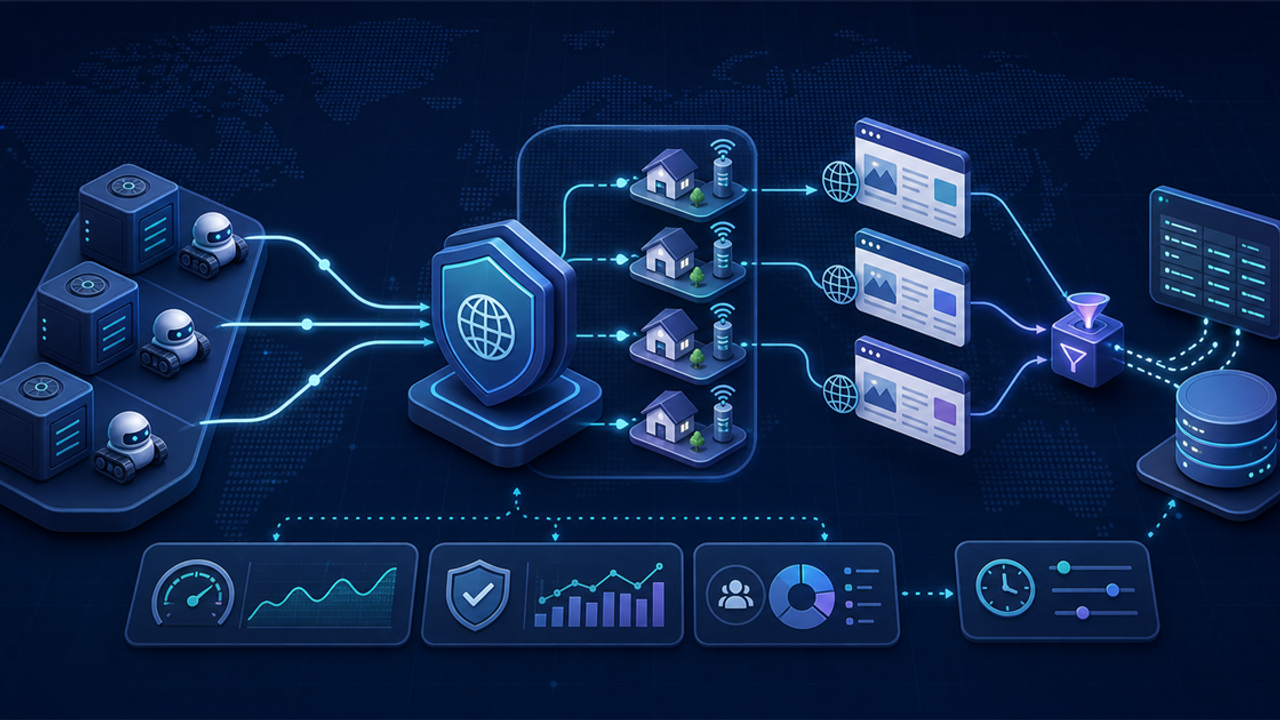
A proxy can give an authorized web-scraping job a controlled network route, a specific region, or a repeatable session. It cannot repair fragile selectors, grant permission to restricted data, or make unlimited request rates acceptable. Reliable collection comes from combining the right proxy policy with access rules, throttling, retries, validation, and observability.
Why scraping projects fail even with proxies
- Rate limits: More IPs do not remove a site's capacity limits. HTTP 429 indicates rate limiting, and Retry-After should drive backoff.
- Session mismatch: Rotating an IP in the middle of a cookie-bound flow can invalidate the session, while independent pages may not need continuity.
- Geographic inconsistency: Search results, prices, stock, and content can vary by region, so the exit location must match the research question.
- Parser drift: Layout changes, localization, experiments, and missing fields create bad records even when requests return 200.
- Hidden conflicts: Environment proxy variables, DNS behavior, TLS trust, and credential formatting can send traffic through an unexpected route.
The practical goal is not to avoid every block. It is to create a measurable collection system that slows down when the target asks, preserves session state when required, and stops when data quality falls.
Match the proxy policy to the workload
Workload | Suitable starting policy | Reason |
|---|---|---|
Stable, permissive public endpoints | Datacenter or one static endpoint | Simple routing and predictable cost |
Independent public pages across regions | Rotating residential with explicit geo selection | Regional coverage without binding unrelated requests to one session |
Multi-step flows with cookies | Sticky residential session or static residential IP | Keeps network identity aligned with session state |
Long-running account or regional monitoring | Dedicated static residential IP | Stable, auditable exit identity |
Residential or mobile routing should not be selected merely because it is harder to classify. Choose it only when the authorized task genuinely requires that network type or location.
An implementable scraping-proxy architecture
Separate the system into an approved job queue, a policy and rate-limit layer, a session-aware proxy controller, a bounded fetcher, a record validator, and observability. This makes connection errors, rate limits, login walls, parser failures, and regional mismatches diagnosable instead of labeling every failure as a bad proxy.
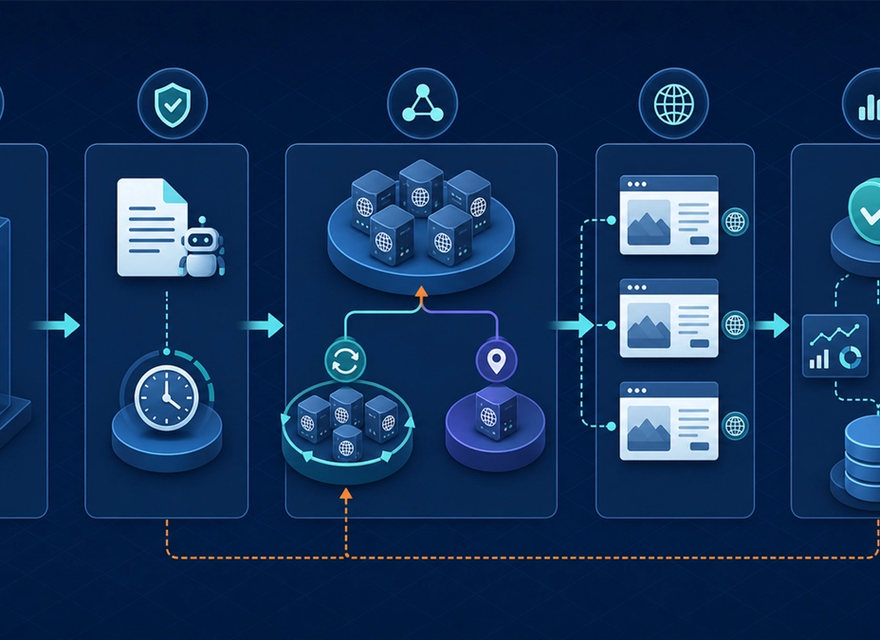
Python: one request with explicit policy
Load the complete proxy URL from a secret store or environment variable. This example stops on rate-limit responses so a scheduler can apply the server's requested delay.
import os
import requests

PROXY_URL = os.environ["SCRAPING_PROXY_URL"]
PROXIES = {"http": PROXY_URL, "https": PROXY_URL}

def fetch_public_page(url: str) -> str:
    response = requests.get(
        url,
        proxies=PROXIES,
        headers={
            "User-Agent": "ExampleResearchBot/1.0 (+contact@example.com)"
        },
        timeout=(10, 30),
    )

    if response.status_code in (429, 503):
        retry_after = response.headers.get("Retry-After", "not provided")
        raise RuntimeError(
            f"Target requested backoff; Retry-After={retry_after}"
        )

    response.raise_for_status()
    return response.text
Requests supports per-request proxy dictionaries and standard proxy environment variables. Its documentation warns that credentials stored in environment variables or version-controlled files can be exposed; use proper secret management for production.
Scrapy: throttle before scaling
Scrapy provides HttpProxyMiddleware, RobotsTxtMiddleware, and AutoThrottle. Start conservatively:
ROBOTSTXT_OBEY = True

AUTOTHROTTLE_ENABLED = True
AUTOTHROTTLE_START_DELAY = 2.0
AUTOTHROTTLE_MAX_DELAY = 60.0
AUTOTHROTTLE_TARGET_CONCURRENCY = 1.0

CONCURRENT_REQUESTS_PER_DOMAIN = 2
DOWNLOAD_DELAY = 1.0
AutoThrottle adjusts delay using observed latency while respecting configured concurrency and delay limits. These values are a safe starting point, not a universal optimum; lower the rate when the target publishes stricter limits or returns errors.
Operating rules that improve reliability
- Prefer an official API, data export, feed, or written permission when available.
- Start with one region, one parser version, and low concurrency.
- Keep one sticky or static identity for cookie-bound flows; rotate only between independent tasks when permitted.
- Respect 429, 503, and Retry-After; use exponential backoff with a retry ceiling.
- Stop retrying authentication walls, CAPTCHAs, or explicit denials and route them to review.
- Validate records before storage and quarantine pages with missing or unexpected fields.
- Keep proxy credentials out of logs and source control; rotate leaked secrets.
- Monitor accepted-record rate, not only HTTP success rate.
Metrics worth monitoring
- Response counts by domain and status; median and tail latency by route; 429/503 frequency and requested wait time.
- Proxy authentication, DNS, TLS, and connection failures; exit-country or state mismatch.
- Parser completeness, duplicate rate, schema drift, bytes, and proxy cost per accepted record.
Avoid provider marketing metrics as your only capacity plan. Run a small authorized pilot against the actual target, then size concurrency and budget from observed accepted records.
Frequently asked questions
Does rotating proxies make scraping automatically reliable?
No. Rotation addresses network-route diversity. It does not fix permissions, rate limits, cookies, JavaScript rendering, parser changes, duplicate records, or poor retry logic.
When should I use a sticky or static proxy?
Use a sticky session or static residential IP when several permitted requests must keep the same network identity. Use rotation between independent jobs when continuity is not required.
Should a crawler obey robots.txt?
RFC 9309 standardizes the Robots Exclusion Protocol as a way for service owners to control crawler access. It is not access authorization by itself, so teams must also evaluate terms, contracts, APIs, and applicable law.
What should happen after HTTP 429?
Reduce the request rate and honor Retry-After when present. Repeatedly changing IPs while maintaining the same load is not a responsible substitute for backoff.
Build a controlled proxy layer
Start with an authorized target, a small job queue, explicit rate limits, and one observable proxy policy. Expand only after data quality and target impact remain acceptable.