

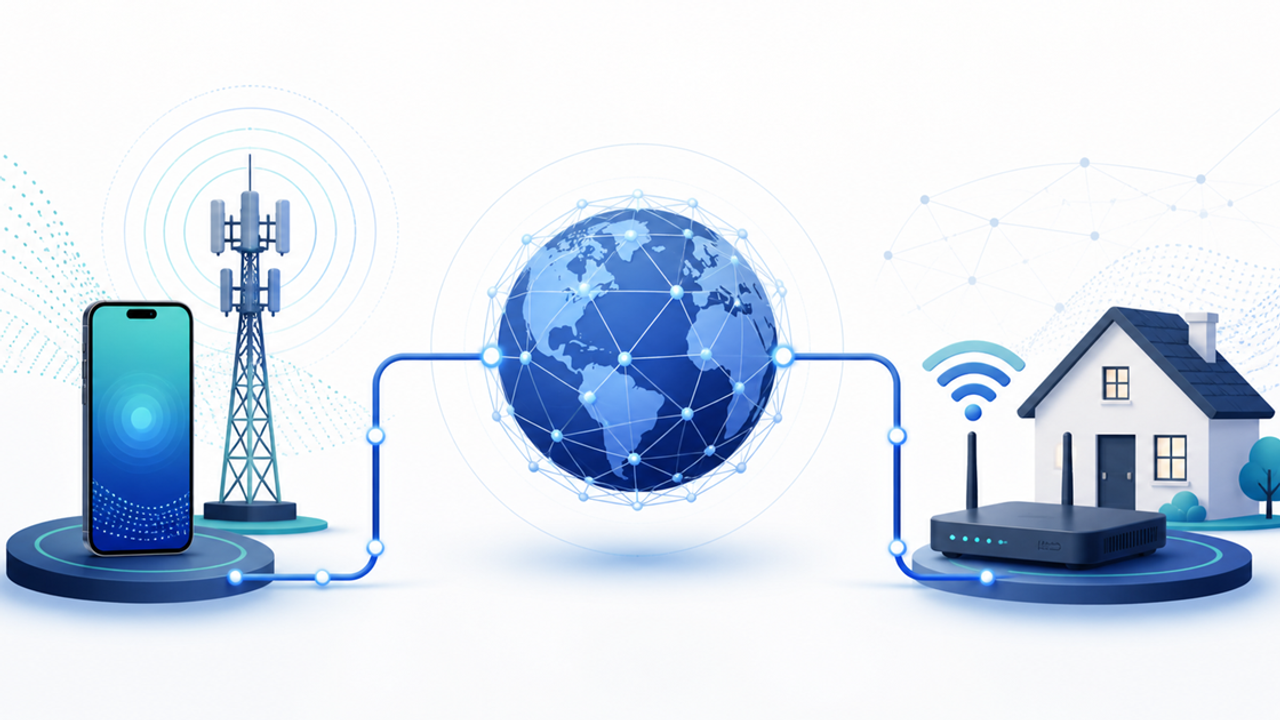
Mobile and residential proxies both route a request through an external exit IP, but the origin network behind that exit is different. That difference affects what you can legitimately test, how sessions may behave, and which operational controls you should put in place.
Core principle: an exit IP is a network characteristic—not permission to bypass access controls, account limits, anti-fraud controls, or a site’s terms.
What is a mobile proxy?
A mobile proxy uses an exit IP associated with a mobile carrier’s cellular network. In a compliant setup, the traffic is relayed through an authorized mobile connection, such as a managed modem or a user-consented device. Research on mobile proxy networks describes mobile devices acting as proxy peers and highlights why consent and traffic governance matter.
Cellular networks can use carrier-grade NAT (CGNAT), so one public-facing IP may represent shared carrier infrastructure rather than one specific handset. RFC 6598 documents the shared-address-space model used with CGN deployments. Actual behavior still varies by carrier, country, device, and service configuration.
- Best suited to authorized testing that genuinely needs a mobile-carrier network context—for example, verifying your own mobile web or app experience.
- Useful for checking whether an allowed service handles cellular routing, regional delivery, or mobile-network edge cases as intended.
What is a residential proxy?
A residential proxy uses an exit IP from a consumer Internet access network, typically a household or fixed-broadband connection rather than a data-center network. A security study characterizes residential IP proxy services as relaying customer traffic through hosts in residential networks.
Residential context can be helpful when an authorized test needs to resemble ordinary fixed-access browsing. It does not prove a person’s identity, grant access to restricted content, or guarantee that an IP’s geolocation data is exact.
- Best suited to permitted regional-content checks, localization QA, and availability testing for sites or services you own or are authorized to assess.
- Can be appropriate for rate-limited, rules-compliant market research where the target explicitly permits the activity.
The practical differences
1. Network source and context
Mobile proxies exit through cellular-carrier infrastructure; residential proxies exit through consumer fixed-access infrastructure. Choose the one that matches the network context of the product behavior you are validating—not the one that seems more likely to evade a control.
2. Session and routing behavior
Mobile connections can be affected by radio coverage, handoffs, device state, and shared carrier networking. Residential connections may be more stable for some fixed-access scenarios, but neither type promises a permanent IP, a precise location, or identical behavior across networks.
3. Appropriate work
The difference is most valuable when the test objective is specific. A carrier-sensitive mobile flow may warrant a mobile exit; a fixed-broadband localization or storefront QA case may warrant a residential exit. For ordinary backend tests, load tests, or security assessments of systems you control, a dedicated test environment is often the cleaner choice.
A quick selection guide
- Choose a mobile proxy when the authorized test must observe a cellular-network or mobile-device path.
- Choose a residential proxy when the authorized test must observe a consumer fixed-broadband context or regional presentation.
- Choose neither when a controlled staging environment, test account, or direct integration test answers the question more safely and reliably.
Compliance and safety checklist
The source of the proxy pool matters as much as the IP category. Before using either type, define the scope, document authorization, and ensure the service’s peer-consent model is clear.
- Use only sources that can explain how participating devices or connections are enrolled and consented.
- Protect access with strong credentials, IP allowlists where appropriate, quota controls, and audit logs.
- Honor the target’s terms, applicable law, and request limits. RFC 9309 standardizes robots.txt rules for crawlers; it is not an authorization mechanism, so it should be paired with explicit permission and respectful behavior.
- Minimize collection and retention of personal data. The NIST Privacy Framework is a useful risk-management reference for data-processing ecosystems.
- Never use a proxy to impersonate a user, defeat access controls, run credential attacks, evade enforcement, or conduct fraud.
Bottom line
Mobile and residential proxies are not interchangeable labels for “better access.” They are network-context tools. Select the type that matches a clearly authorized test, keep the scope narrow, and make consent, security, and privacy part of the design from the start.
Sources
NDSS 2021 — Your Phone is My Proxy: Detecting and Understanding Mobile Proxy Networks
Mi et al. (2019) — Resident Evil: Understanding Residential IP Proxy as a Dark Service
IETF RFC 6598 — IANA-Reserved IPv4 Prefix for Shared Address Space