
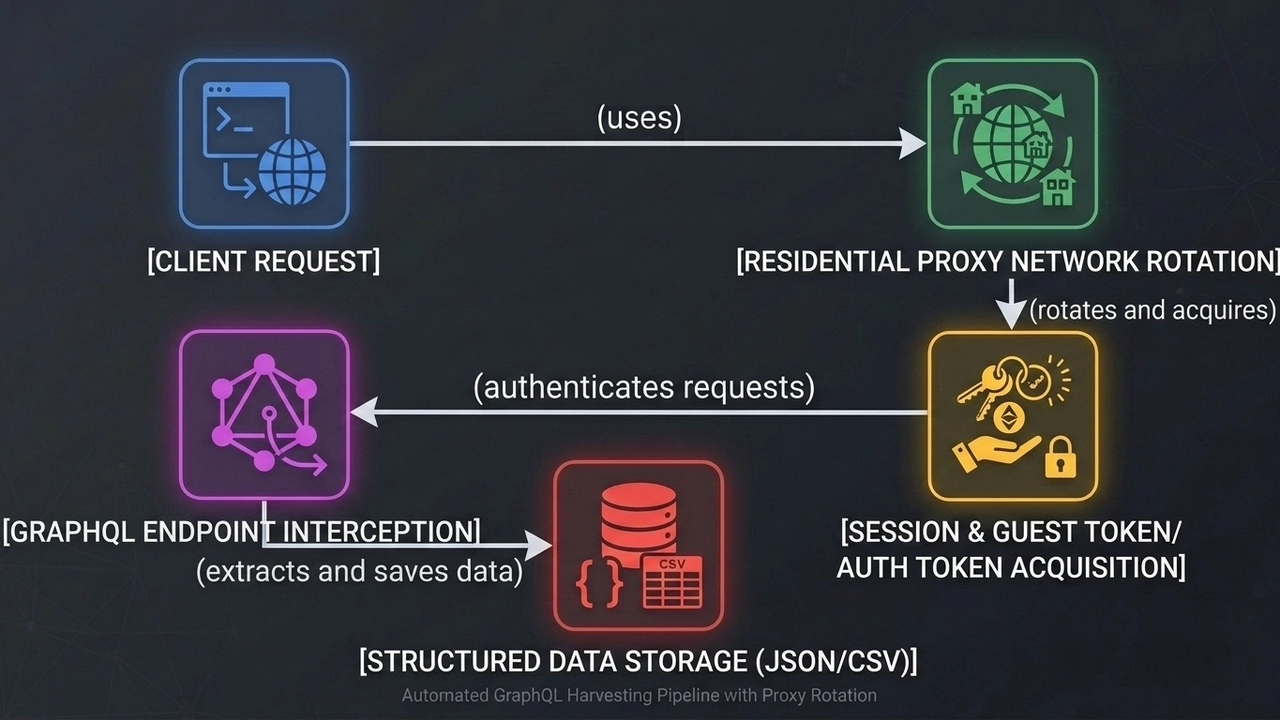
In 2026, reliable Twitter scraping with Python starts with access authorization. Teams should use the official X API or a browser workflow covered by X's written permission, then apply disciplined request controls, structured extraction, and privacy governance. Playwright or Selenium can still be useful for owned or explicitly authorized pages, while MiyaIP residential proxies provide routing, location targeting, rotation, and sticky sessions; a proxy does not grant permission to access X.
2026 Twitter Scraping Strategy Breakdown
The modern stack combines Python 3.11+, asynchronous I/O, the official X API or an authorized browser, and a documented data-governance layer. The objective is predictable collection rather than bypassing login walls, access controls, or rate limits.
X Scraping at a Glance in 2026
Parameter | Operational Target / Specification |
|---|---|
Recommended Tech Stack | Python 3.11+, official X API or authorized Playwright/Selenium, Asyncio, and optional MiyaIP routing |
Access Basis | Published X interfaces or express written permission for the browser workflow |
Rate Control | Documented quotas, exponential backoff, conservative concurrency, and stop conditions |
Cost Model | API usage plus any authorized proxy and compute costs; actual results vary and are not guaranteed by MiyaIP |
Core Pipeline Workflow
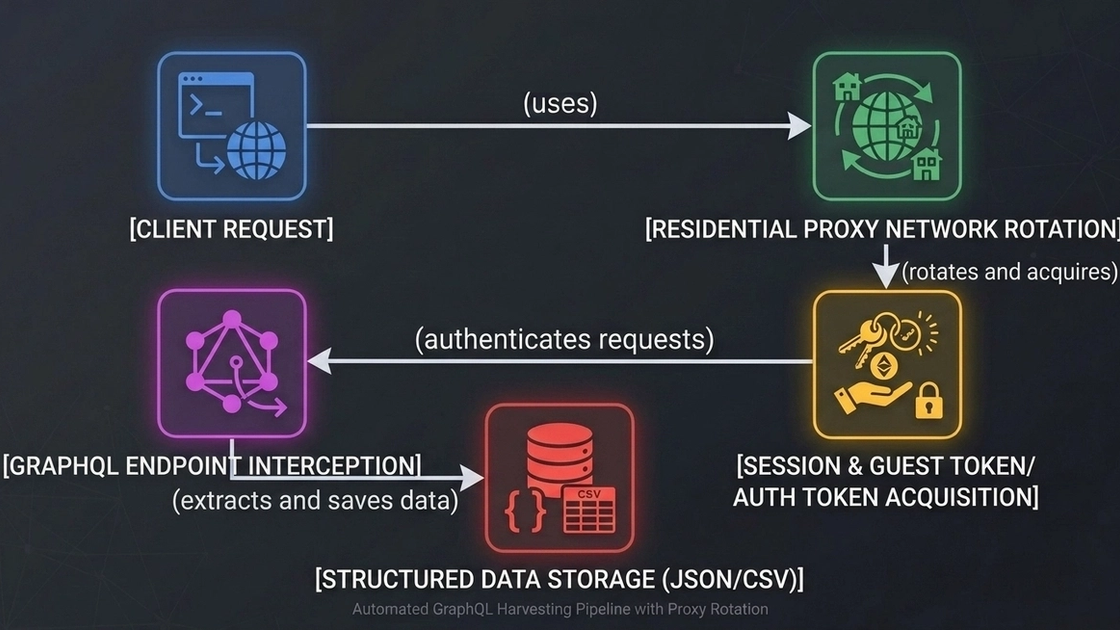
Cloudflare introduced Precursor on July 13, 2026 as a session-based client-side verification system that continuously evaluates behavioral signals. In a separate July 1 report, Cloudflare said non-human traffic had crossed 50% of Internet traffic. These are distinct claims and do not establish a universal success rate for scraping X.
Is Twitter web scraping still working in 2026?
Technically, dynamic pages can still be rendered and observed by a browser. Operationally, however, X's current Terms prohibit scraping without prior written consent and prohibit working around technical limitations. A production design must therefore begin with the official API or written authorization rather than with a method for defeating controls.
Official API v2 vs. Custom Web Scraper
Evaluation Metric | Official X API | Authorized Python Browser Workflow |
|---|---|---|
Access Basis | Published interface governed by X Developer terms and scopes | Only for owned pages or a workflow covered by express written permission |
Pricing | Pay-per-usage credits, with endpoint-specific rates | Variable proxy, browser, storage, and compute costs |
Data Completeness | Limited to documented endpoints, fields, scopes, and account permissions | Limited to the exact pages and fields included in the authorization |
Maintenance Overhead | Lower interface maintenance, but API versions and policies still change | Higher maintenance because page behavior and authorized response formats may change |
Why Compare Browser Collection with the X API?
The official X API is the default route for programmatic X data. An authorized browser workflow is relevant when a team owns the target experience, is testing its own integration, or has a separate written agreement covering browser automation. It is not a substitute for API authorization.
As of August 17, 2026, X documents pay-per-usage pricing. Post reads are listed at $0.005 per resource and the pay-per-use plan is capped at three million Post reads per monthly billing cycle; current rates must always be rechecked in the Developer Console.
Cost & ROI Model: X API Pricing vs. Authorized Browser Scaling
Monthly Volume Target | Illustrative Official X API Post-Read Cost | Authorized Browser Infrastructure Cost | Planning Note |
|---|---|---|---|
100,000 Posts | Approximately $500 at $0.005 per Post read | Depends on bandwidth, compute, storage, and the permitted workflow | No automatic cost advantage should be assumed |
1,000,000 Posts | Approximately $5,000 at $0.005 per Post read | Workload-specific and subject to written authorization | Compare total cost of ownership, not proxy spend alone |
3,000,000 Posts | Approximately $15,000; documented pay-per-use monthly cap | Requires a separately scoped architecture and permission review | Higher volume may require an Enterprise arrangement |
Introduction & Industry Landscape
As demand grows for real-time social intelligence, X and other platforms continue strengthening Web Application and API Protection. Modern defenses evaluate network reputation, session continuity, documented credentials, browser behavior, and request volume rather than relying on a single IP rule.
Why is scraping Twitter so hard now?
X is a JavaScript-heavy application with strict access rules, dynamic interfaces, and granular quotas. The engineering challenge is no longer only parsing HTML; teams must select an allowed interface, handle schema changes, respect controls, and govern personal or copyrighted data.
The Anti-Bot Defense Failure Loop
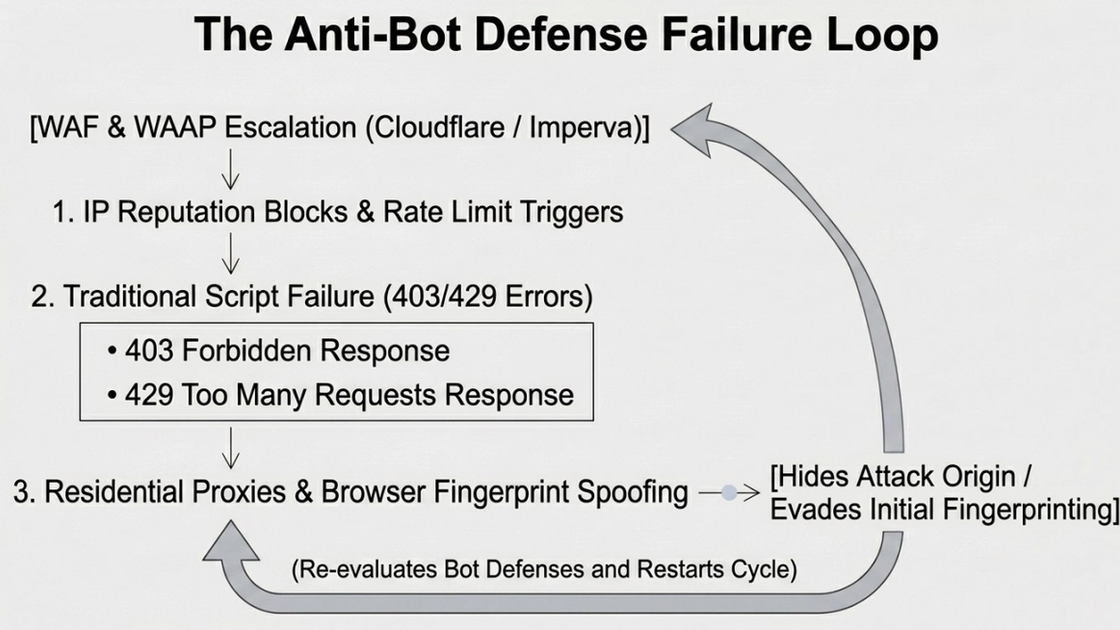
The Evolving Anti-Scraping Barrier on X
Anti-automation systems combine network, transport, protocol, and behavioral signals. A compliant system treats these signals as policy boundaries: it uses supported clients, sends documented credentials, follows quotas, and stops when access is denied.
How should teams respond to the Twitter login requirement?
Do not automate around a login gate or reuse credentials outside their approved purpose. Use an official API flow, a user-authorized application flow, or written authorization that explicitly defines the browser workflow and data scope.
The 4-Tier Security Defense Architecture on X
Defense Layer | Security Mechanism | Compliant Response |
|---|---|---|
1. Network Layer | IP and ASN reputation, connection-rate controls | Use an approved route, conservative concurrency, and documented geographic requirements |
2. Transport Layer | TLS and HTTP behavior consistency | Use standard maintained clients; do not alter transport identity to defeat controls |
3. Protocol Layer | Documented authentication, scopes, and API quotas | Use official credentials and refresh flows only as documented |
4. Behavioral Layer | Managed challenges and session-risk scoring | Stop automation, preserve evidence, and move to an approved or human-reviewed path |
This response model reduces compliance and account risk while making failures diagnosable. A high-quality pipeline records why collection stopped instead of trying to conceal the event.
Business Value & ROI of Authorized X Data Collection
What business data can you collect from Twitter?
When the relevant interface, agreement, and privacy basis permit it, structured X data can support market research and operational analysis. Public visibility alone is not authorization, and the permitted fields and retention period must be defined before collection.
Commercial Data Applications on X
- Public Opinion & Sentiment Analysis: analyze permitted posts and replies to identify aggregate brand themes and emerging issues.
- Brand Reputation Management & Competitor Research: compare public campaign activity within the limits of the approved interface.
- KOL & Influencer Discovery: evaluate consented or permitted engagement signals without building intrusive personal profiles.
- Lead Research: use only fields and purposes supported by law, platform rules, and a documented lawful basis.
- Model Evaluation: use X content only where the applicable X agreement expressly permits the intended machine-learning use; the current Developer Agreement restricts foundation-model training with licensed X content.
Foundation & Concept Mapping
X exposes documented developer interfaces with application credentials, access tokens, scopes, and rate limits. These supported mechanisms replace the source document's unsafe focus on extracting internal credentials from the website.
What credentials are needed for an authorized X integration?
The exact credentials depend on the documented endpoint and whether the application acts on behalf of a user or in an application context. Create credentials in the Developer Console, store secrets outside source code, request only necessary scopes, and rotate or revoke them through supported controls.
X Platform Authentication & Network Mechanisms
Authentication Component | Supported Form | Operational Function |
|---|---|---|
Developer Application | App registered in the X Developer Console | Defines the application identity, products, callbacks, and access context |
OAuth Access | Documented user or application authorization flow | Grants scoped access without exposing a user password to the application |
Scopes and Permissions | Least-privilege endpoint permissions | Limits which resources and actions the application can access |
Secret Storage | Environment variable or managed secret store | Keeps credentials out of code, logs, screenshots, and published examples |
Bind each credential to its documented purpose and keep audit records for creation, use, rotation, and revocation. Network continuity can improve reliability, but it cannot expand the credential's scope.
Route Selection: Authorized Response Observation vs. HTML DOM Parsing
For a page you own or are expressly allowed to automate, observing same-origin XHR or fetch responses may provide cleaner structured payloads than repeatedly parsing rendered HTML. This architectural comparison does not authorize observing X internal endpoints.
Should I parse HTML or observe responses in Playwright?
Choose the mechanism explicitly covered by the authorization. DOM parsing is transparent and closely tied to what a user sees; response observation can reduce selector fragility when the owner has approved access to those responses. Both approaches require rate controls and schema validation.
Technical Performance: DOM Parsing vs. Authorized Response Observation
Metric / Dimension | HTML DOM Parsing | Authorized Response Observation |
|---|---|---|
Extraction Mechanism | Reads rendered elements available to the authorized session | Listens to approved same-origin XHR or fetch responses |
CPU & RAM Overhead | Often higher because the rendered page and selectors are processed | Can be lower for structured responses, but still requires a browser |
Pagination Handling | Scroll or documented UI actions followed by selector reads | Captures approved incremental responses triggered by documented actions |
Data Cleanliness | Requires text, attribute, and layout normalization | May provide structured JSON when the site owner permits access |
Schema Stability | Affected by visible UI and selector changes | Affected by response-contract changes and authorization scope |
Taxonomy & Comparative Analysis
Dynamic residential proxies can rotate egress IPs, target country, city, or ASN, and maintain sticky sessions. Static residential proxies provide longer-lived ISP-sourced sessions. These capabilities support authorized localization, availability testing, and public-web collection, but they do not change X's terms or grant access.
Which proxy model fits an authorized workflow?
Use dynamic residential routing for permitted workloads that need controlled rotation or location coverage. Use static residential routing when a permitted session needs continuity. Select a datacenter route when cost and predictable infrastructure matter more than consumer-network locality.
Python Automation Framework Matrix
Feature / Metric | Playwright | Selenium | Scrapy + Playwright | Puppeteer / Pyppeteer |
|---|---|---|---|---|
Execution Model | Modern async and sync browser APIs | Mature WebDriver model | Asynchronous crawl scheduler plus browser rendering | Browser automation with ecosystem-dependent Python support |
Network Observation | Native request and response events | Available through browser or driver integrations | Available through Playwright handlers and middleware | Native request and response events |
Concurrency Model | Good for bounded browser concurrency | Commonly process or worker based | Strong queueing and pipeline control | Good in JavaScript; Python maintenance varies |
Python Ergonomics | First-party Python API | Broad Python community support | Powerful but more configuration-heavy | Prefer maintained packages and verify project status |
Best Fit | Authorized dynamic pages and integration testing | Legacy browser suites and broad compatibility | Large authorized crawl pipelines | JavaScript-centric teams or verified Python ports |
Proxy Network Architecture Comparison
Dimension | Dynamic Residential Proxy | Static Residential Proxy | Datacenter / Commercial VPN |
|---|---|---|---|
Session Model | Rotating or sticky sessions | Stable ISP-sourced session continuity | Usually stable server or shared exit sessions |
Location Control | Country, city, and ASN targeting where available | Fixed location attached to the assigned address | Location depends on the provider's facilities |
Typical Authorized Use | Localization tests, distributed public-web research, and permitted crawling | Account continuity and long-running permitted sessions | General server traffic, CI testing, and low-cost automation |
Cost Structure | Usually traffic based | Usually address or plan based | Usually IP, server, or subscription based |
Important Caveat | Rotation must not be used to evade platform controls | A stable address does not grant account or content access | Shared exits may behave differently from consumer networks |
Core Python Scraping Toolchain Analysis
Playwright's request and response events plus async/await support make it a strong choice for authorized JavaScript pages. Selenium remains useful where a mature WebDriver ecosystem or existing test suite is the primary constraint.
Is Playwright better than Selenium for a Twitter scraper?
There is no universal winner. Playwright offers convenient network events and context isolation; Selenium offers broad compatibility and mature tooling. Performance depends on browser version, page complexity, concurrency, blocked resource types, and workload design, so the unsupported percentage claims in the source document have been removed.
Execution Logic: Event-Driven Playwright vs. Polling-Driven Selenium
Playwright event model: launch an approved browser context -> attach a response hook -> navigate to the authorized page -> observe same-origin responses -> validate and store permitted fields.
Selenium polling model: launch WebDriver -> navigate to the authorized page -> wait for approved elements -> parse visible content -> repeat only within documented limits.
For high-volume authorized crawlers, Scrapy with scrapy-playwright can combine concurrency, pipelines, persistence, and JavaScript rendering. Keep the permission boundary in middleware so workers cannot expand the target host or field set.
Authorized Proxy Topology: Residential vs. Datacenter vs. VPN
Different networks produce different routing, localization, and continuity characteristics. Avoid universal claims that one network is always blocked or always successful: results depend on the destination, permission model, traffic pattern, region, and current platform controls.
Why can datacenter and consumer-network routes behave differently?
Datacenter addresses are associated with hosting infrastructure, while residential services route through ISP-sourced addresses. Risk engines may evaluate those categories alongside many other signals. For an approved workflow, choose the route that matches the documented test or collection requirement rather than the route most likely to conceal automation.
IP Routing & Session Profile Matrix
Network Type | Session Model | Location Control | Typical Permitted Use | Governance Requirement |
|---|---|---|---|---|
Datacenter IP | Stable server address | Facility or region based | CI, monitoring, APIs, and general automation | Declare automation and follow the destination's controls |
Static Residential | Long-lived ISP-sourced address | Fixed assigned location | Permitted sessions requiring continuity | Bind the session to its approved account and purpose |
Dynamic Residential | Rotating or sticky ISP-sourced address | Country, city, or ASN targeting where supported | Authorized localization and distributed collection | Cap rotation and never use it to evade a denial |
Commercial VPN | Shared or dedicated exit | Provider location selection | Manual testing and secure access | Account for shared-exit behavior and provider policy |
MiyaIP dynamic residential proxies support rotation and sticky sessions, while static residential proxies support longer session continuity. Neither product guarantees acceptance by X or any other destination.
Typical Commercial Scenarios & Production Pipelines
Authorized posts, replies, and engagement fields can feed sentiment, entity, and trend analysis. Commercial value depends on data quality, representativeness, privacy controls, and the legal and contractual basis for collection; percentage gains from the source document should be treated as illustrative rather than guaranteed.
How to collect posts for sentiment analysis?
Use the official X API or a written-authorized workflow to collect the minimum fields required for the analysis. Normalize text, remove unnecessary identifiers, document sampling bias, and pass the resulting dataset to a reviewed NLP or LLM classifier only when the intended model use is permitted.
End-to-End Social Data Processing Architecture
Authorized interface -> data validation and minimization -> PII review or anonymization -> sentiment and entity analysis -> governed CRM or analytics storage.
Primary Enterprise Use Cases
- Sentiment Analysis & Brand Monitoring: aggregate permitted mentions and replies to identify themes and emerging risks.
- Consented Lead Research: enrich only fields covered by a lawful basis and outreach policy.
- Competitor Intelligence & Market Research: compare approved public campaign and engagement metrics without intrusive profiling.
- Ad Integrity Analysis: audit placements and aggregate suspicious engagement patterns through permitted data channels.
Actionable Blueprint & Implementation
A production-grade workflow rests on three pillars: an explicit access basis, conservative rate controls, and audited data governance. Proxy health and session continuity are reliability concerns, not permission mechanisms.
How to build a production-grade Twitter data workflow in Python?
Begin with the official X API. If X has expressly authorized a browser workflow, use a maintained browser, restrict navigation to the approved host, log only permitted same-origin responses, and stop on denial or verification challenges.
5-Step Production Architecture Blueprint
Authorized X Data Collection Workflow
Define the data scope, purpose, and authorization
List the exact posts, profiles, metrics, time range, and business purpose. Record the official API entitlement or X written permission, applicable privacy basis, retention period, and prohibited uses.
Choose the official API or a written-authorized browser route
Use the official X API whenever it covers the required data. Use browser automation only when the owner controls the target or X has expressly approved the workflow, host, fields, and request behavior.
Configure MiyaIP routing with environment variables
Store MIYAIP_USERNAME and MIYAIP_PASSWORD outside the code. Use gateway.miyaip.com:10000 and choose rotation or sticky sessions according to the approved localization and continuity requirements.
Collect and normalize only authorized fields with Playwright
Set AUTHORIZED_PUBLIC_URL to a page you own or are expressly allowed to automate. The example logs same-origin XHR and fetch responses for integration diagnostics; it does not target X, extract credentials, or defeat controls.
import asyncio import os from urllib.parse import urlparse from playwright.async_api import async_playwright PROXY_SERVER = "http://gateway.miyaip.com:10000" PROXY_USERNAME = os.environ["MIYAIP_USERNAME"] PROXY_PASSWORD = os.environ["MIYAIP_PASSWORD"] TARGET_URL = os.environ["AUTHORIZED_PUBLIC_URL"] ALLOWED_HOST = urlparse(TARGET_URL).hostname async def main(): async with async_playwright() as p: browser = await p.chromium.launch( headless=True, proxy={ "server": PROXY_SERVER, "username": PROXY_USERNAME, "password": PROXY_PASSWORD, }, ) context = await browser.new_context() page = await context.new_page() async def handle_response(response): response_host = urlparse(response.url).hostname if ( response_host == ALLOWED_HOST and response.request.resource_type in {"xhr", "fetch"} ): print(response.status, response.url) page.on("response", handle_response) await page.goto(TARGET_URL, wait_until="domcontentloaded") print(await page.title()) await browser.close() if __name__ == "__main__": asyncio.run(main())Enforce rate limits, minimization, retention, and audit
Apply bounded concurrency and exponential backoff. Stop on denied access, minimize personal data, encrypt storage, record lineage, delete data on schedule, and review downstream CRM or model use.
Step-by-Step Production Architecture
The Playwright example above keeps credentials in environment variables, restricts response logging to the target host, and uses a generic authorized URL. If the intended target is X, obtain the necessary X authorization first or use the official API instead.
SLA Maintenance, Rate Limits & ASN Verification
Operational reliability comes from bounded queues, retry budgets, health checks, and clear stop conditions. Monitor proxy reachability and ASN metadata only to confirm that routing matches the approved configuration, not to continue after a platform denial.
How to handle Twitter HTTP 429 Too Many Requests
HTTP 429 means the request rate exceeded the applicable limit. Pause the worker, honor Retry-After when supplied, apply exponential backoff with jitter, reduce concurrency, and verify the documented quota. Do not switch identities or routes to bypass the limit.
Risk Mitigation State Machine for X Data Collection
HTTP Status Code | Detected System State | Compliant Action & Retry Logic | Next State |
|---|---|---|---|
HTTP 200 OK | Authorized request succeeded | Validate the response, store permitted fields, and continue within the quota | Active Collection |
HTTP 429 Too Many Requests | Rate limit reached | Pause, honor Retry-After, apply exponential backoff, and lower concurrency | Backoff |
HTTP 403 Forbidden | Access denied or permission insufficient | Stop automation, preserve logs, and verify account, scope, agreement, and target URL | Authorization Review |
HTTP 400 / 404 | Invalid request, unavailable resource, or interface change | Validate against current official documentation; do not probe undisclosed interfaces | Configuration Review |
A production SLA should measure authorized availability, data quality, retry volume, and policy-stop events. No provider can guarantee uninterrupted access to a third-party platform.
LLM Era: AI & Agentic Data Collection Trends
Generative AI can help generate parsers, classify schema changes, summarize logs, and map permitted fields. The same systems can also create privacy, copyright, and policy risks if agents expand scope or attempt to resolve challenges autonomously.
How does AI affect web scraping on Twitter?
AI improves maintainability when it operates inside a fixed allowlist and produces reviewable changes. Verification challenges, new login requirements, or unexpected modals should trigger a stop and human review rather than autonomous circumvention.
Traditional vs. AI-Assisted Governed Systems
Dimension | Traditional Rule-Based Paradigm | AI-Assisted Governed Paradigm |
|---|---|---|
Detection Logic | Fixed status, quota, and schema checks | Anomaly classification with deterministic policy gates |
Parser Adaptability | Manual updates when documented fields change | AI proposes mappings; a reviewer approves before deployment |
Interaction Model | Fixed waits and documented navigation | Agent suggests actions inside an allowlist and request budget |
Verification Handling | Stop and escalate to an operator | Stop, preserve context, and request human review |
Auditability | Structured logs and change tickets | Prompts, proposals, approvals, and outputs retained for audit |
Vision-language models may help an authorized QA team understand a changed interface, but they should not be used to solve access challenges or impersonate a human user.
Conclusion & Actionable Next Steps
The key to enterprise-grade X data collection is pairing the correct interface with Python tooling, conservative rate controls, and privacy governance. MiyaIP can provide dynamic or static residential routing for permitted workflows, but does not provide X authorization, a dedicated Twitter API, or guaranteed access.
How to start collecting Twitter/X data safely today
- Confirm that the official X API covers the required fields; otherwise obtain written permission before designing browser automation.
- Document the target hosts, fields, account context, request rate, geographic requirements, and retention period.
- Configure MiyaIP only for the approved routing requirement, using rotation or sticky sessions deliberately.
- Run the authorized Playwright example in a controlled environment and validate logs before storing any response data.
- Review privacy, security, deletion, and downstream-use controls before production rollout.
Enterprise X Data Collection Implementation Checklist
- Tech Stack Confirmation: use a maintained Python environment and a published API or written-authorized browser workflow.
- Proxy Provider Evaluation: verify routing coverage, protocol support, rotation controls, and sticky-session behavior without treating them as access guarantees.
- Credential Management: store only official application credentials or authorization artifacts in a managed secret store.
- Compliance & Ethics Self-Audit: minimize personal data, document lawful purpose, enforce conservative request rates, and honor deletion requirements.
Whether you use the official API or an authorized browser service, long-term stability depends on respecting the interface contract, retaining evidence of permission, and stopping when the target changes the access boundary.
FAQ
Is scraping Twitter legal, and how can I stay compliant while avoiding free proxies?
There is no blanket rule that public visibility makes automated collection lawful or contractually permitted. X's current Terms expressly prohibit scraping without prior written consent. Use the official API or obtain written permission, review applicable privacy and copyright law, minimize data, and avoid free proxies that lack clear sourcing, security, and accountability.
What should I do if my workflow gets stuck in a Turnstile or CAPTCHA loop?
Stop the automated session. A repeated verification challenge indicates that the current route is not accepted for automated access. Preserve the logs, verify authorization and the target URL, use the official API where available, or request an approved human-reviewed path. Do not automate around the challenge.
Can I collect X (Twitter) data without logging into an account?
Only through a published interface or another route that X has expressly authorized. A page being visible without login does not by itself permit automated collection. Check the official API, the current X Terms, and the exact agreement covering your use case.
Sources & Compliance References
X Terms of Service - current access and scraping restrictions.
X API Pricing - pay-per-usage pricing and current Post-read limits.
X Automation Rules - rules for API-based and non-API automation.
Cloudflare Precursor - July 13, 2026 session-based verification announcement.
Cloudflare Agentic Internet Report - separate July 1, 2026 non-human traffic statement.
Disclaimer
This article is for educational and informational purposes. It does not provide legal advice or permission to access X. Readers are responsible for complying with applicable laws, privacy obligations, copyright rules, X agreements, and target-site controls. This article is independent and is not affiliated with, sponsored by, or endorsed by X Corp.
Configure reliable routing for a permitted data workflow
Use MiyaIP dynamic residential proxies for controlled rotation and location targeting, or explore the general-purpose Web Crawler for public pages you are authorized to collect.