
Is Scraping Google Search Results Still Possible in 2026?
Short answer: Yes, but the legacy playbook is dead.
As Google bakes AI Overviews deep into its SERP layout, web data collection has evolved from parsing static HTML into rendering dynamic, modular UI components.
At the same time, enterprise anti-bot protection (WAAP & Bot Management) has undergone a massive paradigm shift. According to Gartner’s Market Guide for Bot Management, modern security barriers now rely on behavioral biometrics, TLS/JA3 fingerprinting, and real-time IP reputation scoring. Attempting Google SERP scraping via raw cURL requests or datacenter IPs now triggers hard blocks or CAPTCHAs over 80% of the time
2026 SERP Scraping Essentials at a Glance
Dimension | Legacy SERP Scraping (Pre-2024) | Modern SERP Scraping (2026) | Tech Stack Solution |
|---|---|---|---|
Page Structure | Static HTML / 10 organic links | Dynamic AI Overviews / Modular UI | Playwright / Headless Rendering / SERP API |
IP Validation | Basic Rate Limiting | Behavior Fingerprinting + ASN Reputation | |
Anti-Bot Defense | Static CAPTCHAs | Behavior-based WAF / TLS Fingerprinting | TLS/JA3 Impersonation + Sticky Sessions |
The Three Rules of 2026 SERP Scraping
Shift from Static Requests to Headless Rendering
AI Overviews components load asynchronously within dynamic DOM nodes. Static regex or rigid XPath rules fail constantly. Reliable extraction requires headless engines like Playwright or self-healing SERP APIs to render and parse full DOM trees.
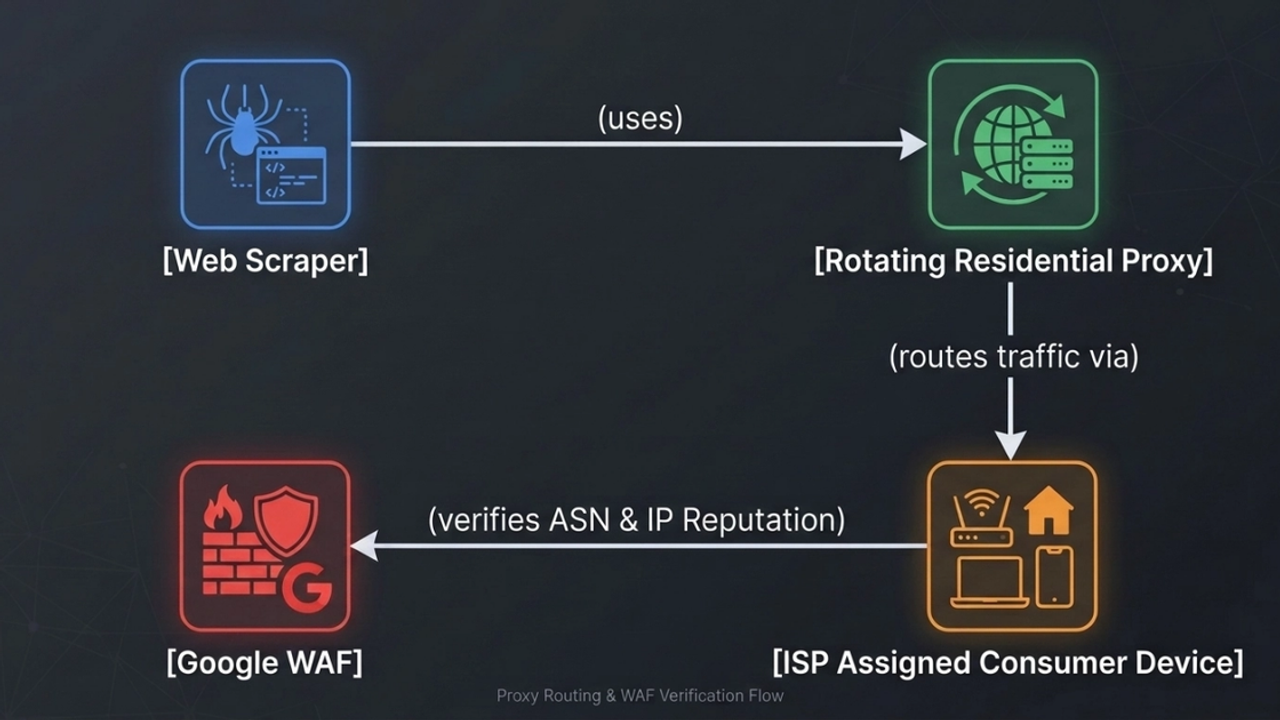
Evade Bot Detection with Rotating Residential Proxies
Google flags datacenter IP ranges instantly. Route requests through rotating residential proxies tied to legitimate consumer ISPs to mimic real user traffic. Proxyway’s industry benchmarks confirm that high-purity residential proxy pools yield a 60%+ higher success rate on Google compared to datacenter proxies.
Master Protocol-Level Fingerprint Impersonation
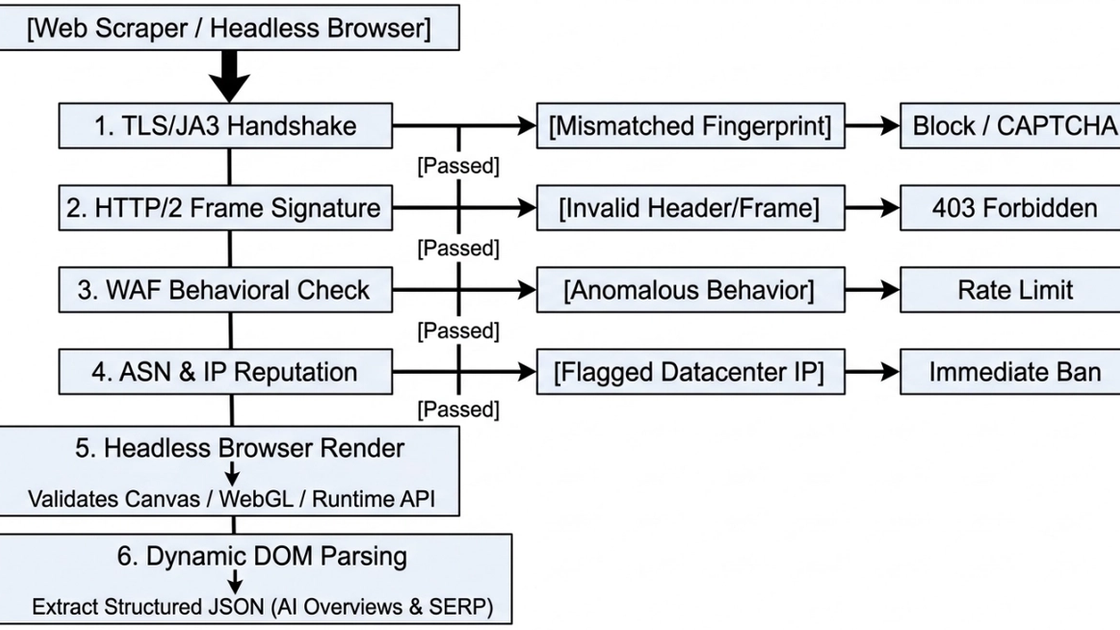
Modern WAFs look far beyond User-Agent headers. They analyze TLS handshake signatures (JA3/JA4) and HTTP/2 frame configurations. To maintain high success rates, your scrapers must match authentic Chrome browser network signatures at the protocol layer.
"Modern Google SERP scraping has shifted from simple HTML parsing to dynamic DOM rendering and multi-layered anti-bot evasion due to AI Overviews and sophisticated WAAP security barriers."
Technical Architecture of Google SERP Data Extraction
"Scraping Google SERP with headless browsers requires bypassing WebGL fingerprinting, canvas detection, and HTTP/2 Frame signatures to mimic authentic consumer browsing patterns."
How to Scrape Google Search Results Without Getting Blocked?
Executing successful Web Scraping against Google SERPs in 2026 requires moving far beyond basic HTTP client libraries like cURL or Python requests. Legacy scripts fail because Google’s security perimeters evaluate the entire client-side execution environment before serving complete SERP payloads.
Modern extraction architectures rely on Browser Automation and Headless Browsers (such as Playwright or Puppeteer) capable of executing complex JavaScript and rendering dynamic DOM trees. However, running a default headless instance is an immediate trigger for Bot Detection systems.
To bypass anti-bot defenses, your scraping pipeline must address three critical client fingerprinting layers:
HTTP/2 Fingerprinting & TLS Signatures: WAFs inspect the TLS client hello (JA3/JA4 signatures) along with HTTP/2 pseudo-header order, stream priorities, and INITIAL_WINDOW_SIZE frame configurations. If your HTTP/2 signature matches a default NodeJS or Python stack rather than a real browser, the request is dropped during the handshake.
WebGL & Canvas Fingerprinting: Security scripts execute headless rendering tests on client GPUs. Standard headless Chrome instances expose specific WebGL renderers (e.g., SwiftShader) that flag the request as automated.
Dynamic DOM Parsing Execution: After passing client checks, the scraper must wait for asynchronous JavaScript calls to complete rendering dynamic elements—such as AI Overviews cards and interactive snippets—before triggering final DOM Parsing routines.
SERP Data Extraction & Anti-Bot Inspection Flow
Dynamic IP Rotation & Proxy Network Mechanisms
"Rotating residential proxies with clean ISP allocations provide the highest success rate for Google SERP scraping by masking scraper traffic as authentic home user connections."
What Is a Residential Proxy IP Address?
A Residential Proxy is an intermediary proxy server that routes network requests through an IP address assigned by a consumer Internet Service Provider (ISP) (such as Comcast, AT&T, or Vodafone) to Real Household Devices.
Unlike a Datacenter Proxy—which originates from data center cloud servers like AWS, DigitalOcean, or Hetzner—a residential IP address carries the trust and reputation profile of an actual home internet user.
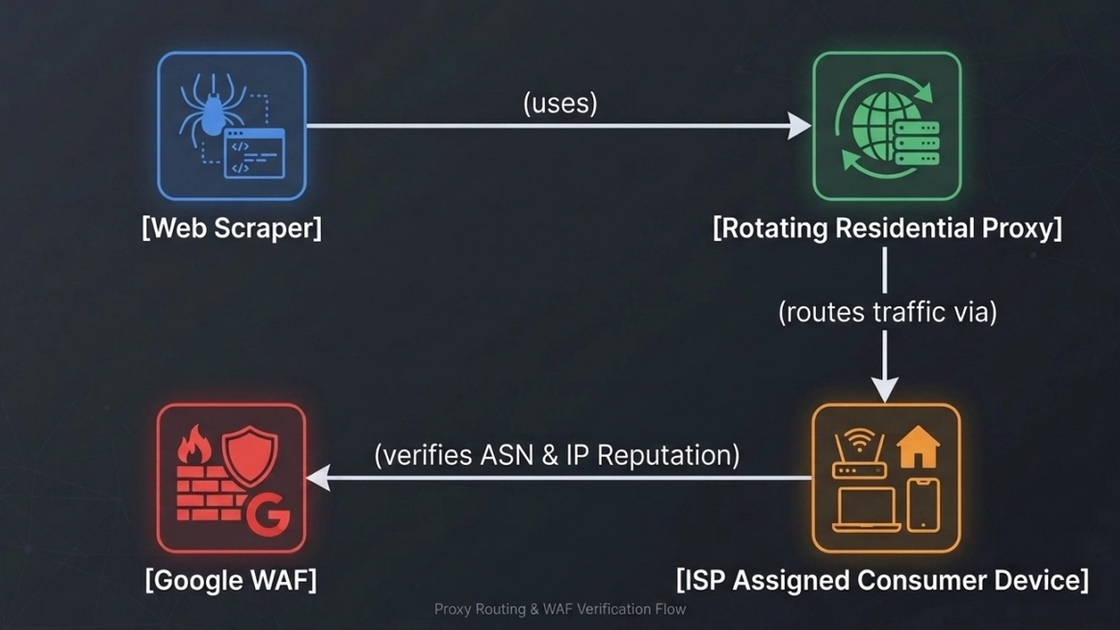
Proxy Network Architecture: Rotating vs. Static ISP
Rotating Residential Proxies: Automatically assigns a new residential IP from a massive global IP Pool for every request or time interval. By constantly changing the IP address, scrapers distribute request volume across millions of distinct nodes, effectively eliminating frequency-based rate limits and dropping the scraper Ban Rate near zero.
Static Residential Proxies (Static ISP): IP addresses hosted on datacenter infrastructure but officially registered under consumer ISP ASN numbers. These provide datacenter-grade latency and high stability for Sticky Sessions, which are required when paginating through multi-page Google SERP workflows without changing identities mid-session.
Why Residential IPs Outperform Datacenter Proxies
Security databases such as MaxMind and Spur categorize IP addresses in real time based on their Autonomous System Number (ASN) and network subnets. When a request hits Google’s perimeter from a commercial datacenter ASN, WAFs apply aggressive challenge rules.
According to global benchmark testing by Proxyway, request success rates on Google SERP vary drastically by proxy type:
Datacenter Proxies: Experience ban rates exceeding 80% due to instant ASN classification.
Rotating Residential Proxies: Achieve success rates above 98% when utilizing ethically sourced, clean ISP pools.
Comparative Matrix: Balancing Cost, Latency, and Ban Rates
"Datacenter proxies offer low cost and sub-second latency but carry an 80%+ blocking rate on Google SERP, whereas dynamic residential proxies maintain <2% ban rates at a higher cost per GB."
Datacenter vs. Residential Proxies vs. VPNs for Google Scraping
A common mistake among development teams is attempting to scrape SERPs using Virtual Private Networks (VPNs) or Datacenter Proxy pools.
VPNs vs. Residential Proxies: VPNs pass traffic through a single, static server location shared among thousands of users. Google flags and blocks VPN IP addresses almost instantaneously, making them unsuitable for automated scraping.
Datacenter vs. Residential Proxies: According to global benchmark tests by Proxyway, datacenter IPs suffer ban rates exceeding 80% on Google due to commercial ASN tags. In contrast, Residential Proxy networks route requests through genuine household ISPs, maintaining a ban rate under 2%.
Multi-Dimensional SERP Extraction Comparison Matrix
Solution / Network Type | Cost Model | Anonymity Level | Ban Rate on Google SERP | Response Latency | AI Overviews Parsing Accuracy | Primary Use Case |
|---|---|---|---|---|---|---|
Datacenter Proxy | Extremely Low ($0.50–$1.50/GB) | Low | High (>80%) | Ultra-Low (<200ms) | Very Low | Non-sensitive public API collection |
Moderate ($2.00–$8.00/GB) | Very High | Very Low (<2%) | Moderate (500–1200ms) | High | High-frequency SERP scraping & geo-targeting | |
Static ISP Proxies | High (Per IP/Month) | High | Low (<5%) | Low (200–500ms) | High | Sticky sessions & multi-page pagination workflows |
Mobile Proxy (4G/5G) | Very High ($10–$20/GB) | Highest | Lowest (<1%) | Higher (800–1500ms) | Highest | Mobile-specific SERP audits & strict WAF bypass |
Managed SERP API | Per 1K Requests ($1.50–$3.00/1k) | N/A (Fully Managed) | Near 0% | Provider-dependent | Auto-Updated | Rapid deployment & zero-maintenance pipelines |
Scraping Architecture Breakdown: Custom Python vs. Headless Clusters vs. Managed SERP APIs
"Commercial SERP APIs outsource proxy management, CAPTCHA solving, and DOM parsing, achieving a 99%+ success rate at the cost of higher per-request API pricing compared to custom-built scraper pipelines."
Should I Build My Own Google Scraper or Use a SERP API?
When scaling Web Data Collection against Google in 2026, engineering teams face a fundamental trade-off between architectural control and operational maintenance. The three dominant implementation paths differ significantly in technical complexity, dev cycles, and hidden infrastructure costs:
Path A: Custom Python Scraper Pipeline (Python Scrapy + Proxy Pool + CAPTCHA Solver)
Technical Barrier: High. Requires custom proxy rotation middleware, protocol-level fingerprinting scripts, and external CAPTCHA Solver integrations.
Development Cycle: 4 to 8 weeks to build an initial enterprise-grade pipeline.
Hidden Maintenance Costs: Extreme. Constant maintenance is required to rebuild broken CSS/XPath selectors and adjust to Google’s updated anti-bot heuristics.
Pros: Complete control over raw data pipelines and lower incremental request costs at massive scale.
Cons: Vulnerable to TLS/JA3 finger-printing and high initial engineering overhead.
Path B: Automated Headless Clusters (Playwright / Puppeteer)
Technical Barrier: Medium-High. Demands expertise in browser automation, WebGL/Canvas fingerprint evasions, and resource orchestration.
Development Cycle: 2 to 4 weeks for initial cluster deployment.
Hidden Maintenance Costs: High. Headless browser instances are CPU and RAM intensive, driving up server infrastructure bills.
Pros: Full JavaScript execution capability, seamlessly capturing dynamic AI Overviews and client-rendered UI components.
Cons: Slower execution speed and higher resource overhead compared to direct HTTP requests.
Path C: Commercial Managed SERP APIs (e.g., Bright Data, Oxylabs)
Technical Barrier: Low. Involves standard REST API calls returning structured JSON payloads.
Development Cycle: Less than 1 day to integrate into production workflows.
Hidden Maintenance Costs: Minimal. The API provider assumes all maintenance for proxy health, CAPTCHA solving, DOM updates, and IP rotation.
Pros: Near 100% SLA, zero infrastructure overhead, and self-healing parsers for AI Overviews.
Cons: Higher per-thousand-request costs compared to managing raw proxies in-house.
Core Business Scenarios: Competitor Monitoring, E-Commerce Price Tracking, and GEO Intelligence
"E-commerce sellers leverage geo-targeted SERP scraping with city-level proxy IP routing to track dynamic Google Shopping prices and localized organic ad placements in real time."
How Do Cross-Border Merchants Track Competitor Google Ads Across Regions?
For cross-border e-commerce brands and B2B enterprises, Google SERP visibility varies dramatically by geographic location. Competitors run hyper-localized Google Ads and dynamic Google Shopping promotions that are invisible from standard datacenter IPs or domestic networks.
To track regional campaigns, cross-border sellers deploy Geo-targeting scraping pipelines paired with city-level residential proxies. By routing scraper requests through local residential nodes in specific ZIP codes (e.g., London, Tokyo, or Los Angeles), brands capture exact SERP layouts, regional ad placements, and localized shopping price feeds in real time.
Furthermore, digital advertising auditors rely on high-frequency Google Shopping Scraping for Ad Verification—ensuring affiliate partners do not hijack branded terms, enforce Minimum Advertised Price (MAP) policies, and verify ad compliance. Organizations like the Trustworthy Accountability Group (TAG) and the Interactive Advertising Bureau (IAB) establish strict benchmarks for digital ad validation and Invalid Traffic (IVT) detection, making clean residential proxies essential for authenticating ad placements without triggering fraud filters.
SERP Data Extraction Field Mapping List
When building automated Market Research pipelines, enterprise scrapers map SERP payloads into structured JSON entities across four critical content modules:
Organic Ranks
Title Tag, Target URL, Meta Snippet, Domain Authority Score, Position Number
AI Overviews & GEO Elements
Synthesized Answer Text, Citations & Source URLs, Recommended Links, Follow-up Query Blocks
Google Shopping & E-Commerce Listings
Merchant Name, Price & Currency, Promotion Badges (e.g., "Sale", "Price Drop"), Rating Stars, Stock Status
PAA (People Also Ask) & Search Intent
Question String, Accordion Snippet Text, Source URL, Entity Topic Association
Enterprise SERP Scraping Architecture Deployment Guide
"Enterprise-grade Google SERP scraping architectures rely on automatic IP rotation per request, sticky session control for pagination, and real-time ASN clean-rate validation."
How to Get a Residential Proxy & Key Vendor Selection Criteria
Acquiring enterprise-grade residential proxies requires partnering with vetted providers that maintain ethically sourced, permission-based IP pools. When evaluating vendors for high-volume Google SERP scraping, DevOps and engineering leaders should benchmark candidates against four strict criteria:
Service Level Agreement (SLA): Demand a minimum SLA of 99.9% uptime and sub-second proxy response latency to ensure pipeline reliability.
IP Pool Purity & ASN Validation: Ensure the provider executes real-time ASN Validation to filter out flagged datacenters, subnet blocks, and burnt residential nodes before traffic is routed.
Geo-Targeting Granularity: Look for city-level and ISP-level targeting options to execute localized SERP data extraction.
Advanced Proxy Pool Management: Select platforms offering automated IP Rotation controls, sticky session configuration, and programmatic API access for real-time pool monitoring.
5-Step Production Deployment Blueprint
Building a resilient, production-ready SERP scraper requires a multi-layered pipeline capable of bypassing modern anti-bot protections automatically.
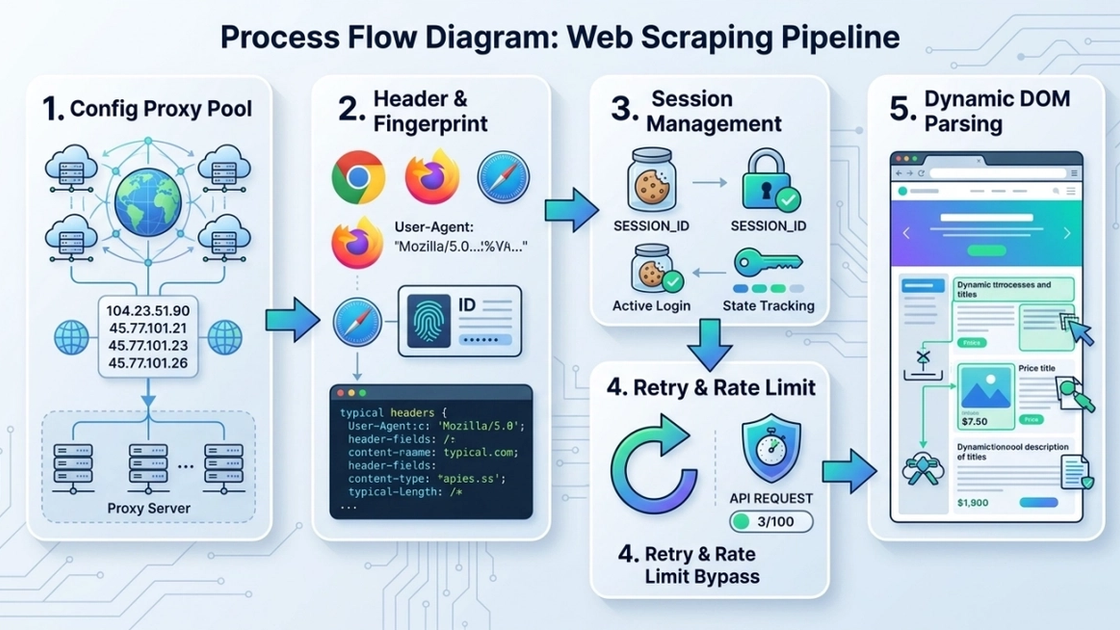
Step 1: Proxy Pool Configuration
Integrate dynamic residential proxy endpoints supporting country- and city-level targeting. Configure your Proxy Pool Management layer to distribute outbound traffic across thousands of distinct residential ASNs to maintain high reputation scores.
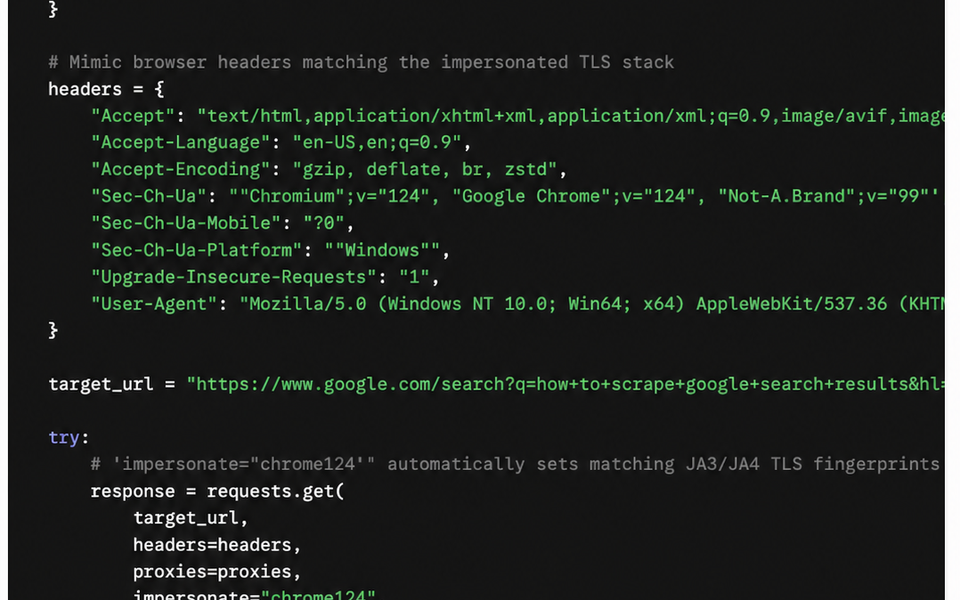
Step 2: Request Header & Fingerprint Management
Align client signatures with real browser profiles. Use libraries like user-agents alongside custom TLS wrappers to match Chrome’s exact HTTP/2 pseudo-header order, header capitalization, and JA3/JA4 TLS fingerprint signatures.
Step 3: Session State Control
Apply context-aware session logic:
Enable per-request IP Rotation for independent SERP keyword queries to maximize throughput and spread request volume.
Enable Sticky Sessions (5–10 minute IP persistence) when paginating through multi-page Google search results to maintain session context without triggering re-authentication checks.
Step 4: Exception Retry & Rate Limit Bypass
Implement a robust circuit breaker and retry mechanism. When encountering HTTP 429 (Too Many Requests), HTTP 403 (Forbidden), or CAPTCHA challenges, immediately trigger exponential backoff, discard the flagged proxy node, and switch to a fresh residential IP to achieve a seamless Rate Limit Bypass.
Step 5: Dynamic DOM Parsing & Fallback
Extract structured data from the rendered page. Pair high-performance CSS/XPath selectors with a lightweight LLM or heuristic fallback parser. If Google updates dynamic DOM class names or AI Overviews components, the fallback parser preserves pipeline uptime while engineers update selector rules.
Future Outlook & Call-to-Action (CTA)
"The future of SERP data collection lies in hybrid proxy networks coupled with LLM-powered dynamic parser engines that adapt automatically to SERP layout changes."
What Is the Future Direction of AI in Google SERP Scraping?
Over the next 2 to 3 years, the arms race between Google’s anti-bot defenses and web scraping pipelines will be defined by full-stack AI automation. As search layouts become increasingly fluid with personalized AI Overviews, legacy static selectors (CSS/XPath) are officially obsolete.
The future of Automated Web Scraping rests on three foundational technological shifts:
LLM Data Scraping & Dynamic Parsing: Future scraping pipelines will integrate lightweight, fine-tuned Vision-LLMs that visually interpret SERP layouts in real time. Instead of relying on hardcoded DOM tags, Dynamic Parsing engines read web pages like human users—identifying titles, prices, citations, and AI-generated snippets purely through semantic context, rendering DOM layout updates completely harmless.
Behavioral AI Counter-Measures: WAFs are deploying deep learning models to inspect client mouse movements, scroll cadence, and request timing variances. Scraper architectures must incorporate AI-generated human behavior simulation to emulate natural consumer navigation patterns.
Adoption of Hybrid Proxy Architectures: Enterprise operations are shifting away from single-proxy models toward a Hybrid Proxy Architecture. By pairing fast Static ISP Proxies for sticky pagination sessions with high-purity Rotating Residential Proxies for initial search requests, engineering teams optimize latency, minimize bandwidth costs, and eliminate IP bans simultaneously.
Market forecasts from IDC highlight that data created at the edge to support enterprise AI workloads is expanding at a compound annual growth rate exceeding 25%. As clean web data becomes the primary feedstock for enterprise AI engines and generative search monitoring, building resilient, AI-adaptive data ingestion infrastructure is no longer optional—it is a core business requirement.
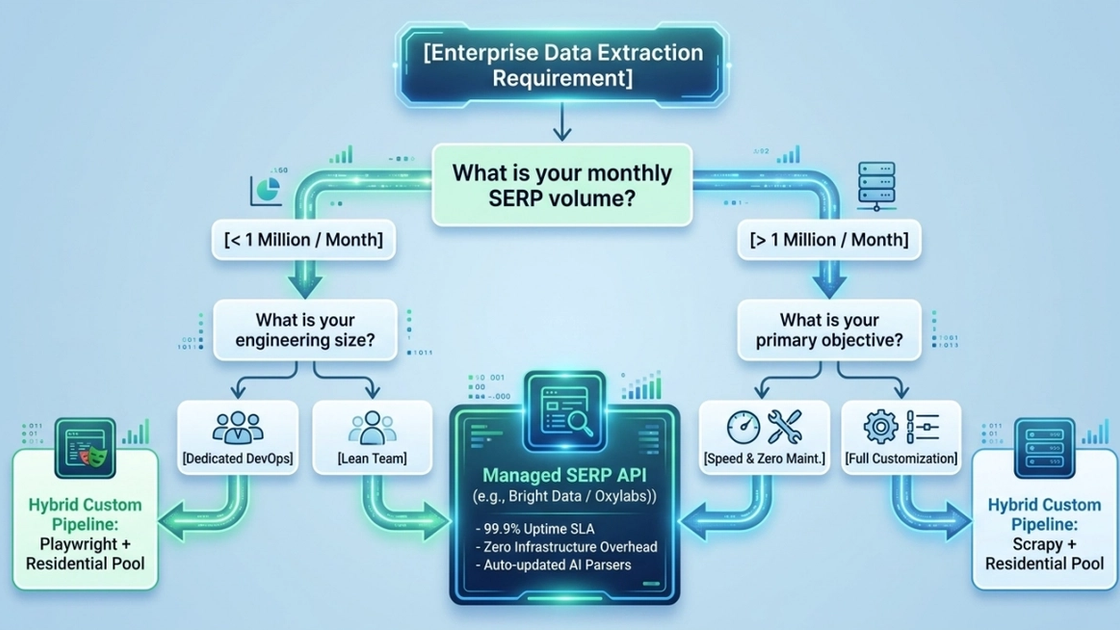
Ultimate SERP Scraper Decision Tree
Use this decision tree to determine whether your organization should engineer an in-house scraping pipeline or integrate a fully managed SERP API:
FAQ:
1. How does custom Google scraping differ from Google Search Console data?
While Google Search Console (GSC) provides authoritative first-party performance metrics, it only reports on websites you directly own. GSC does not provide real-time rank tracking for competitor domains, nor does it capture visual SERP elements like AI Overviews, localized ad units, or Google Shopping panels. Automated Google scraping allows growth and data engineering teams to gain full-market visibility across any keyword, region, or competitor set.
2. Why not use the official Google Custom Search API or Google Search API instead of web scraping?
The official Google Custom Search API (and standard Google Search API developer endpoints) offers structured output, but it comes with strict operational limitations:
Incomplete SERP Coverage: Official APIs omit critical SERP features, including dynamic AI Overviews, local 3-packs, competitor ad extensions, and live Google Shopping feeds.
Cost & Quotas: Scaling official API requests to millions of queries per month quickly becomes cost-prohibitive compared to deploying a managed Google scraper API or custom proxy pipeline.
3. Is a browser-based Google scraper extension viable for automated data collection?
A Chrome-based Google scraper extension is useful for quick, ad-hoc keyword checks or manual data sampling. However, browser extensions route requests through your local device IP, triggering Google CAPTCHAs and rate limits after only a few dozen requests. Enterprise-grade workflows require headless browser orchestration (Playwright/Puppeteer) paired with rotating residential proxies to achieve high throughput without blocks.
4. What is the difference between a custom proxy pipeline and a commercial Google scraper API?
A custom pipeline provides full control over data transformation and lower raw infrastructure costs at massive volume (1M+ queries/month), but requires constant maintenance for proxy health and DOM updates. Conversely, a managed Google scraper API handles IP rotation, TLS fingerprinting, and CAPTCHA solving automatically, delivering structured JSON payloads with guaranteed SLAs.
Summary
Navigating Google SERP scraping in 2026 requires moving from static request scripts to dynamic, AI-resilient pipelines. Whether you build a custom headless architecture powered by Rotating Residential Proxies or leverage a fully managed SERP API, success hinges on clean IP reputation, protocol-level TLS fingerprinting, and adaptive parsing engines.
For Engineering & DevOps: Audit your current proxy pool purity against ASN databases and upgrade your browser automation stack to support full DOM rendering and TLS/JA3 impersonation.
For Product & Growth Leaders: Evaluate your GEO strategy today by tracking brand citations across Google AI Overviews to capture AI-driven search traffic
Disclaimer:
This guide is for educational and informational purposes only and does not constitute legal advice. Readers are solely responsible for ensuring their data extraction practices comply with applicable privacy laws (such as GDPR and CCPA) and the target platform's Terms of Service.
Sources
- Google Terms of Service — effective July 30, 2026
- Google robots.txt
- Google Search Help — automated queries and unusual traffic
- Google Search Console API overview
- Google Search Analytics query reference — updated August 11, 2026
- Google Custom Search JSON API overview
- Playwright documentation — Locators
- Google Search Central — optimizing for generative AI features
- Proxyway — Proxy Market Research 2026