


Companies rarely adopt a proxy service simply to “change an IP.” They use it to make a business workflow repeatable: checking regional prices, verifying ad delivery, collecting public data, or keeping a stable network identity for an approved operational task.
Evidence note: The scenarios below are representative case studies built from MIYAIP’s documented product capabilities and use cases. They are not named customer testimonials, and they do not claim customer-specific performance improvements.
From an approved business task to a validated result
Most company deployments follow the same pattern: define an approved public-web task, select the appropriate proxy type and location, route requests with the required rotation or session policy, validate the returned page, and send structured results to a monitoring or review system.
The proxy is only one control in the pipeline. Teams still need rate limits, error handling, source-specific rules, data-quality checks, credential protection, and review processes.
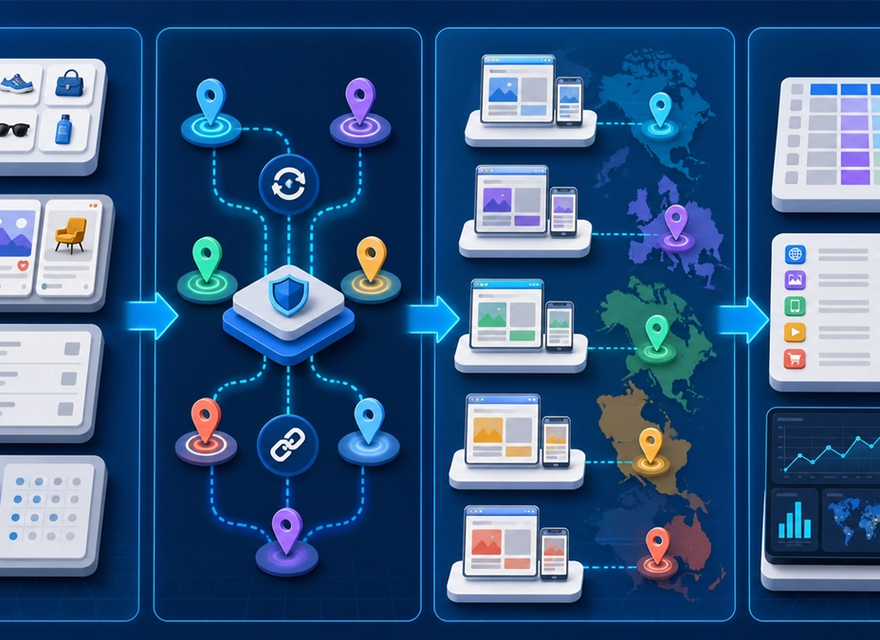
Case 1: A retail intelligence team monitors regional prices
Situation
A retailer or marketplace analytics team needs to compare public product prices, stock status, search placement, and promotions across multiple regions. A single office connection may not show the same localized page that customers see elsewhere.
Intervention
The team routes scheduled collection jobs through dynamic residential proxies selected by target country or city. Rotation is used for broad catalog coverage, while a sticky session is used when a multi-page flow needs continuity. Product identifiers, target regions, timestamps, and expected page fields are defined before collection begins.
Operational outcome
The result is a region-aware dataset that can feed price alerts, stock comparisons, and exception reviews. The team should measure coverage completeness, data freshness, retry rate, and cost per successfully validated product page rather than assuming the proxy alone guarantees data quality.
Case 2: A marketing team verifies ads and localized landing pages
Situation
An advertising team needs evidence that campaigns, creatives, and landing pages appear correctly in selected markets and mobile-network conditions. The team also needs to distinguish a genuine campaign issue from a routing, consent, or localization difference.
Intervention
The workflow uses dynamic residential proxies for country- or city-aligned checks and dynamic mobile proxies when carrier or mobile-network context matters. A controlled session policy keeps a verification journey consistent long enough to inspect the ad, click path, and landing page.
Operational outcome
Checks can be organized into a review queue with region, device profile, timestamp, page result, and captured evidence. Useful measures include expected-versus-observed coverage, broken landing-page rate, and the share of results that require manual review. These are workflow metrics to track—not performance claims made by this article.
Case 3: An operations team needs a stable regional identity
Situation
Some approved account, browser, or automation workflows work better when the outbound IP and location remain consistent. Frequent IP changes can add unnecessary noise to session troubleshooting and audit trails.
Intervention
The team assigns dedicated static residential IPs by the required country or state and binds each IP to a defined environment or task owner. Credentials are stored securely, access is limited, and the IP-to-workload mapping is documented. Static residential service is selected because MIYAIP describes it as long-lived, dedicated, and suitable for stable account and automation workflows.
Operational outcome
The team gains a repeatable network environment that is easier to document and diagnose. It should still monitor expiration, renewal timing, outbound-IP consistency, and access-policy compliance; a static IP does not remove the need for account security or platform rules.
Case 4: A data or SEO platform runs scheduled public-web jobs
Situation
A data engineering or SEO team operates high-volume queues for public listings, keyword checks, price monitoring, or scheduled automation. The main priorities are throughput, concurrency, and cost control, while some target sites do not require residential network context.
Intervention
The team uses dedicated datacenter proxies for fast, repeatable batch jobs. For sustained workflows where GB-based billing is a poor fit, it evaluates a Dynamic Unlimited plan based on duration and bandwidth. Routing, retries, concurrency, and target-specific limits are configured separately from the proxy credentials.
Operational outcome
The pipeline has a clearer resource model for scheduled workloads and can separate fast datacenter tasks from jobs that require residential routing. Teams should compare successful records per run, queue completion time, error categories, and total cost per usable output before scaling.
What companies measure after deployment
- Coverage: Did the workflow reach the required regions, pages, or inventory?
- Validity: Did the returned content match the intended location and task?
- Freshness: How long elapsed between a source change and the recorded result?
- Reliability: Which failures came from routing, the target page, parsing, or business logic?
- Unit economics: What was the total cost per validated page, check, record, or completed workflow?
- Governance: Were access rules, retention limits, credentials, and review requirements followed?
Choosing the right MIYAIP product
- Choose Dynamic Residential for broad public-web collection, localized e-commerce intelligence, ad verification, and workflows that benefit from rotation or controlled sticky sessions.
- Choose Dynamic Mobile when carrier-level mobile context, location, or mobile-app testing is central to the task.
- Choose Static Residential for long-lived, dedicated, location-stable environments.
- Choose Datacenter when speed, concurrency, and batch cost control matter more than residential network context.
- Evaluate Dynamic Unlimited for sustained high-traffic workflows that are better budgeted by time and bandwidth than by GB.
Build a measurable pilot before scaling
Start with one approved workflow, a small region set, and explicit success criteria. Record traffic, retries, page validity, freshness, and total cost. Scale only after the pilot shows which routing model produces usable outcomes for the task.